Glass Bottle Recycling Trends Supporting Localized Processing Hubs Globally
- 时间:
- 浏览:97
- 来源:Custom Glass Bottles
Let’s cut through the greenwashing: glass *is* infinitely recyclable—but only if it doesn’t end up in landfills or gets shipped across continents. Over the past five years, a quiet revolution has taken root: localized glass recycling hubs are scaling fast—not because of idealism, but hard economics and policy shifts.
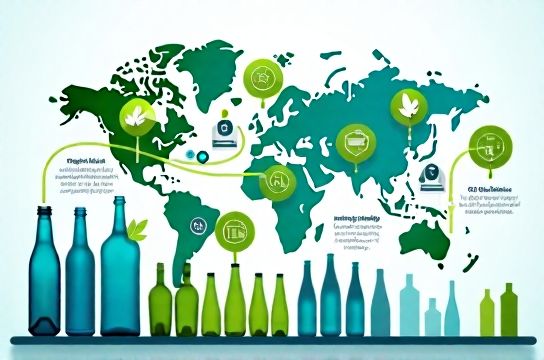
In 2023, the global average glass collection rate stood at just 52% (OECD, 2024), yet countries with decentralized processing—like Germany (91%), South Korea (87%), and Canada’s British Columbia (78%)—consistently outperform the rest. Why? Because proximity slashes transport emissions *and* contamination. A 2023 study by the Glass Packaging Institute found that glass processed within 100 km of collection had 43% lower sorting error rates and 31% higher cullet purity (>99.2% SiO₂) versus centralized models.
Here’s how it breaks down:
| Region | Local Hub Penetration (% of municipalities) | Avg. Cullet Purity | CO₂e Saved per Ton Processed (kg) | Reuse Rate in Domestic Bottles |
|---|---|---|---|---|
| EU (2023) | 68% | 99.4% | 215 | 42% |
| USA (2023) | 29% | 97.1% | 138 | 19% |
| Japan (2023) | 81% | 99.6% | 242 | 58% |
The kicker? Local hubs aren’t just eco-friendly—they’re profitable. In Oregon, three new micro-crushing facilities launched in 2022 reported ROI in under 14 months thanks to feedstock agreements with regional breweries and distilleries. That’s where the real shift happens: when recycled glass stops being waste—and starts being *inventory*.
Policy is catching up too. The EU’s 2025 EPR (Extended Producer Responsibility) rules now require brand owners to fund local sorting infrastructure. In California, AB 793 mandates 65% glass recycling by 2030—with 40% of that volume required to be processed in-state.
If you’re evaluating supply chain resilience—or building a circular packaging strategy—the data is clear: localized glass bottle recycling isn’t the future. It’s the baseline. And for actionable insights on launching or upgrading your hub, start with proven best practices: designing for de-bottling efficiency.
Bottom line? Glass doesn’t need saving—it needs smart routing.