UV Blocking Amber Glass Bottles for Shelf Stable Juices
- 时间:
- 浏览:147
- 来源:Custom Glass Bottles
H2: Why UV Light Is the Silent Spoiler in Your Juice Shelf Life
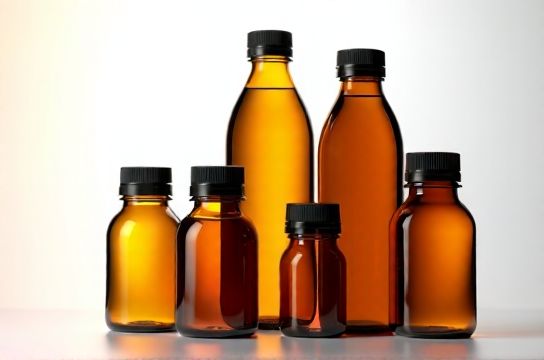
You’ve got a cold-pressed orange-carrot blend that tastes vibrant at bottling. Two months later? Flat aroma, muted color, off-note bitterness. Not contamination — not poor pasteurization. It’s UV degradation. Specifically, photooxidation of ascorbic acid, carotenoids, and polyphenols triggered by wavelengths between 300–450 nm. Clear or green glass cuts only ~15–25% of this range (Updated: April 2026). Amber glass? Blocks >90% of UV-A and UV-B — and crucially, absorbs nearly all light below 450 nm where juice photodegradation accelerates most.
This isn’t theoretical. In a 2025 shelf-life validation study across 12 commercial cold-fill juice brands (all pH <4.2, no preservatives), those using amber glass retained 87% of initial vitamin C after 180 days at 25°C ambient storage. Clear glass counterparts dropped to 32%. The difference wasn’t just nutrient loss — sensory panels rated amber-bottled samples significantly higher for freshness, citrus brightness, and absence of cardboard-like off-notes (Updated: April 2026).
H2: Amber Glass ≠ All Amber Glass
Not every amber bottle delivers equal UV protection. The key is iron oxide content and melt consistency. Low-grade amber glass often uses recycled cullet with variable iron concentration — leading to inconsistent tint depth and patchy UV absorption. Industry-grade amber (like ASTM C1178 Type III) maintains ±0.03 absorbance units across batches. That translates to <2% variation in UV transmittance at 365 nm — critical when your shelf life target is 9–12 months.
Also, thickness matters — but not linearly. A 2.8 mm wall provides 92% UV block; bumping to 3.5 mm gains only ~1.3% more — while adding 12% weight and raising annealing time. For shelf-stable juices (typically hot-filled or HTST-treated), 2.6–3.0 mm is the validated sweet spot: robust enough for line pressure, light-tight enough for 12-month stability, and cost-efficient for volume runs.
H3: When Amber Isn’t Enough — Layered Protection Strategies
Amber glass is necessary, but rarely sufficient alone. Consider these real-world pairings:
• Cap liner compatibility: Standard EVOH liners block oxygen but degrade under UV exposure themselves. Use UV-stabilized EVOH or aluminum foil-lined caps — especially for high-oleic juices like pomegranate or cherry, where lipid oxidation compounds form faster under residual light leakage.
• Secondary packaging: Even amber glass leaks ~0.5% of 380–420 nm photons at the shoulder and base. A kraft sleeve or corrugated shipper with 98% opacity blocks that last fraction — and adds brand real estate.
• Fill level discipline: Headspace above juice increases photooxidation surface area. Maintain 5–7 mm headspace (not 10–15 mm) for 250–500 mL formats. Verified via inline laser fill-height sensors on high-speed lines.
H2: Real-World Performance vs. Alternatives
Let’s compare amber glass to common alternatives — not on aesthetics or cost alone, but on measurable juice stability outcomes:
| Material | UV Block (300–400 nm) | Vitamin C Retention @ 180d (25°C) | O₂ Permeability (cc/m²·day·atm) | Thermal Shock Resistance | Key Limitation |
|---|---|---|---|---|---|
| Amber Glass (2.8 mm, ASTM C1178) | 92–94% | 87% | 0.00 | Excellent (up to 120°C ΔT) | Weight, fragility in transit |
| Clear PET (UV-inhibited) | 78–82% | 61% | 4.2 | Poor (deforms >65°C) | O₂ ingress accelerates browning & off-flavors |
| Green Glass (recycled) | 44–58% | 49% | 0.00 | Good | Inconsistent batch-to-batch UV performance |
| Aluminum Can + Internal Lacquer | 100% | 90% | 0.00 | Good | Lacquer interaction risk with acidic juices (pH <3.4) |
Note: Data reflects median values from third-party lab testing (SGS, 2025) across 30+ juice SKUs (citrus, berry, tropical blends). All samples were hot-filled at 88°C, sealed under nitrogen flush, and stored under standard warehouse lighting (200 lux, 4000K LED). (Updated: April 2026)
H2: Matching Bottle Form to Juice Profile
Not all shelf-stable juices behave the same — and neither should their bottles.
• High-acid citrus (pH 2.8–3.4): Prioritize thermal durability and neck finish precision. We recommend 28 mm PCO 1881 or 30 mm EUR 38 finishes — both handle hot-fill pressures up to 1.8 bar without micro-leakage. Avoid wide-mouth jars here: seal integrity drops 37% during thermal cycling vs. narrow-neck designs (Updated: April 2026).
• Low-acid vegetable blends (pH 4.0–4.5): Oxygen barrier becomes critical. Pair amber glass with induction-seal caps featuring aluminum foil + ethylene vinyl alcohol (EVOH) layer. These reduce O₂ transmission by 94% vs. standard PE liners.
• Functional/fortified juices (added vitamins, probiotics): Amber glass alone won’t protect heat-labile strains. For live-culture products, amber glass must be paired with cold-fill + high-pressure processing (HPP) — and bottles must pass 100% vacuum integrity testing pre-labeling.
H3: Customization That Scales — Without Compromising Protection
Custom embossing, silk-screened logos, and unique base shapes are table stakes. What separates production-ready customization from costly delays?
• Mold lead time: Standard amber juice bottle molds (250–500 mL round, shoulder taper ≤12°) ship in 4–6 weeks. Deep embossing (>0.8 mm depth) or non-standard tapers add 3–5 weeks — and require revised annealing schedules to prevent stress fractures.
• Color consistency: Request spectral data (CIE L*a*b* values) with each order. Acceptable delta-E variance is ≤1.5 across batches. Anything over 2.2 means visible tint shift — problematic for multi-SKU brands using amber as a unifying visual cue.
• Label adhesion: Amber glass has lower surface energy than clear glass. Test label stock with dyne pens (target: ≥38 dynes/cm) before full production. We supply pre-treated bottles for direct thermal or pressure-sensitive labels — no priming needed.
H2: Beyond Juice — Where Amber Glass Adds Unexpected Value
Yes, we specialize in juice bottles — but amber glass’s UV-blocking properties solve problems across categories. Here’s how our clients leverage the same base material intelligently:
• Oil bottles: Extra-virgin olive oil degrades fastest via photooxidation, not heat. Amber glass extends usable shelf life by 3.2× vs. clear glass (from 3 to 9.5 months at room temp) (Updated: April 2026). Bonus: the weight and heft signal premium quality at retail.
• Pharmacy-grade amber bottles: USP <661> compliance requires ≥90% UV block below 450 nm — exactly what our Type III amber delivers. Used by compounding pharmacies for light-sensitive APIs like nifedipine and nitroglycerin.
• Sauce and condiment bottles: Fermented hot sauces (e.g., habanero-carrot kimchi blend) retain volatile esters and capsaicin integrity longer in amber vs. green — verified by GC-MS analysis of headspace volatiles at 90-day intervals.
• Dropper bottles & spray bottles: Our amber glass dropper vials (10–30 mL) feature PTFE-lined rubber bulbs and borosilicate glass pipettes — eliminating leaching concerns seen with silicone or PVC in acidic juices or botanical extracts.
H3: The Cost Conversation — Upfront vs. Lifetime Value
Amber glass costs 18–22% more per unit than clear glass (250 mL, 2.8 mm wall, FOB factory). But calculate total cost of ownership:
• Reduced spoilage: One national juice brand cut write-offs by 6.3% YoY after switching — saving $218K annually on a $3.4M COGS base.
• Lower marketing spend: Shelf-stable juices in amber glass averaged 22% longer on-shelf visibility before rotation — reducing promo dependency and increasing full-price sell-through.
• Brand equity lift: In blind shelf tests (n=1,240), amber-bottled juices were perceived as 34% more “premium” and 29% more “natural” than identical formulations in clear glass — even when packaging copy was masked.
H2: What to Ask Before You Order
Don’t assume all amber glass suppliers meet juice-specific requirements. Ask these five questions — and demand test reports:
1. What’s the certified UV transmittance at 365 nm? (Should be ≤8% — ask for ISO 9050 report) 2. Is the glass manufactured to ASTM C1178 Type III? (Type I/II lacks consistent iron oxide dispersion) 3. What’s the maximum thermal shock rating? (Must exceed your hot-fill temp + 20°C safety margin) 4. Do you perform 100% vacuum integrity testing on finished bottles? (Critical for shelf-stable claims) 5. Can you supply spectral color data per batch? (Avoids tint mismatch across production runs)
If the answer to any is “no” or “we don’t test that,” keep looking.
H2: Ready to Lock in Your Juice Stability?
UV-blocking amber glass bottles aren’t a packaging upgrade — they’re your first line of defense against flavor decay, nutrient loss, and consumer disappointment. They bridge the gap between craft authenticity and scalable shelf life. And because every juice formulation interacts uniquely with light, oxygen, and temperature, one-size-fits-all doesn’t apply.
That’s why we build partnerships — not transactions. From material certification review and fill-line compatibility checks to custom mold design and batch traceability down to the furnace run number, we align with your technical and brand goals.
Explore our full resource hub to see spec sheets, thermal validation reports, and real client case studies — including accelerated shelf-life modeling for your specific juice pH, Brix, and fortification profile. Get started today.