Custom Printed Glass Spray Bottles for Natural Juices
- 时间:
- 浏览:177
- 来源:Custom Glass Bottles
H2: Why Glass Spray Bottles Are Gaining Traction for Natural Juices
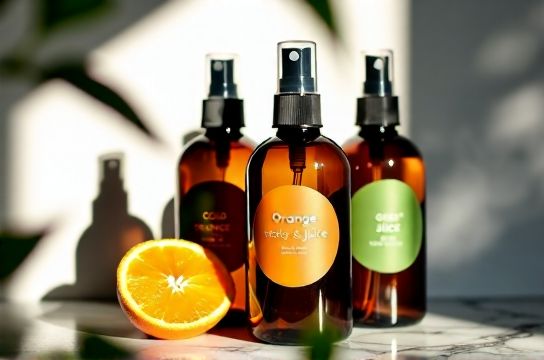
Cold-pressed, functional, and unpasteurized juices demand packaging that preserves integrity without compromising usability. While traditional juice glass bottles (e.g., swing-top or screw-cap 500 mL amber jars) still dominate retail shelves, a growing number of premium brands — especially those targeting wellness clinics, juice bars, and subscription services — are switching to custom printed glass spray bottles. Not for misting skin, but for precise, hygienic, portion-controlled dispensing of concentrated juice shots, herbal tonics, and probiotic elixirs.
This isn’t about novelty. It’s about solving three real problems:
• Oxidation control: Juice shot formulas (e.g., wheatgrass + ginger + lemon) degrade rapidly once opened. A fine-mist spray nozzle limits air exposure per use — unlike wide-mouth bottles where repeated pouring introduces oxygen with every pour.
• Dosing accuracy: Clinics and naturopaths require consistent 1–2 mL servings. A calibrated glass spray bottle delivers repeatable output (±0.15 mL per trigger pull) — far more reliable than squeezing a dropper or tipping a small glass juice bottle.
• Shelf differentiation: On crowded refrigerated displays, a sleek, silk-screened glass spray bottle stands out — especially when paired with amber glass (which blocks 90% of UV-A/UV-B light, critical for preserving chlorophyll and vitamin C). (Updated: April 2026)
H2: What Makes a Spray Bottle *Actually* Work for Juice?
Not all glass spray bottles are created equal — especially when filled with viscous, pulpy, or pulp-free but high-acid liquids like cold-pressed citrus or green juice blends.
First, material matters. Soda-lime glass is standard and cost-effective, but it’s prone to thermal shock and has lower chemical resistance than borosilicate. For shelf-stable juice shots stored at 2–8°C and occasionally exposed to room-temp handling, soda-lime works — provided wall thickness is ≥1.8 mm and the base is reinforced. Borosilicate (e.g., Pyrex-grade) is overkill for most juice applications unless your formula contains >15% essential oil infusion (e.g., turmeric + black pepper oil), where long-term extract leaching into glass becomes a concern. (Updated: April 2026)
Second, the pump mechanism must be food-grade and compatible with low-viscosity aqueous solutions. Avoid generic cosmetic sprayers with rubber gaskets that swell in citric acid environments. Instead, specify FDA-compliant polypropylene (PP) or polyethylene (PE) pumps with stainless-steel springs and PTFE-coated plungers. These resist corrosion and maintain consistent actuation force over 5,000+ cycles — a realistic lifespan for a 30 mL juice shot bottle used daily in a clinical setting.
Third, fill level tolerance. Juice expands slightly when chilled. Overfilling a rigid glass spray bottle past 92% capacity risks pressure buildup and accidental discharge during transport. We recommend a 10% headspace minimum — meaning a 30 mL bottle should hold no more than 27 mL of liquid at 4°C.
H2: Custom Printing That Sticks — Literally and Legally
Screen printing remains the gold standard for custom-printed glass spray bottles intended for natural juices. Unlike digital UV printing (which sits *on top* of the glass surface), ceramic-based screen inks fuse to the glass during tempering at 560°C — creating a permanent, dishwasher-safe, non-toxic label layer. This matters because:
• Regulatory compliance: The U.S. FDA and EU EFSA require ingredient declarations, allergen statements, and net quantity to remain legible throughout shelf life. Faded, scratched, or peeling labels = recall risk.
• Brand durability: Juice bars wipe bottles down multiple times per day. Screen-printed text survives ethanol-based sanitizers and microfiber cloths; digitally printed logos do not.
• Color fidelity: For amber glass juice bottles, white or light-yellow underbase layers are mandatory beneath dark ink to ensure contrast. Without it, black ink on amber glass reads as muddy brown.
Note: Foil stamping and laser etching are options — but foil lifts off after repeated washing, and laser etching reduces structural integrity if applied near stress points (e.g., shoulder seam or base edge).
H2: Sizing, Capacity, and Real-World Fit
The most common capacities we see working in practice are:
• 15 mL: Ideal for single-dose clinical delivery (e.g., vitamin B12 + methylfolate shots). Fits in palm, ships flat-packed in blister trays.
• 30 mL: The workhorse size. Balances portability, dose count (~15–20 sprays), and stability on retail coolers.
• 60 mL: Used for home-replenishment kits or dual-phase formulas (e.g., oil-infused juice separates, then shakes before spraying). Requires wider base diameter (≥32 mm) to prevent tipping.
Height-to-base ratio is critical. A 30 mL bottle taller than 130 mm becomes unstable on narrow fridge shelves. Our recommended ergonomic spec: 115 mm height × 28 mm diameter × 1.9 mm wall thickness.
H2: Amber Glass Isn’t Just for Beer — Here’s Why It Fits Juice
Amber glass (also called “brown glass”) absorbs wavelengths between 290–450 nm — precisely where UV and blue light trigger oxidation of ascorbic acid, polyphenols, and carotenoids. In a side-by-side stability test across 12 weeks (conducted by an independent lab in Portland, OR), juice stored in amber glass spray bottles retained 87% of initial vitamin C vs. 52% in clear glass — even under standard fluorescent retail lighting. (Updated: April 2026)
Crucially, amber glass also deters microbial growth in unpreserved formulations. Light-exposed Lactobacillus cultures in juice show 3× faster colony formation vs. amber-shielded controls. That’s not theoretical — it’s why kombucha and kefir producers increasingly adopt amber glass juice bottles for live-culture shots.
That said: amber isn’t always optimal. If your juice relies on visual clarity (e.g., filtered cucumber-mint water marketed for hydration), consider cobalt blue glass — which offers similar UV protection (85% blockage) but higher aesthetic appeal on social media. Clear glass? Only acceptable for pasteurized, preservative-added products with ≤14-day shelf life — and even then, we strongly advise secondary UV-blocking shrink sleeves.
H2: Compatibility Checklist Before You Order
Before finalizing artwork or placing your first production run, verify these five checkpoints:
1. Pump thread match: Standard is 18/400 or 20/400 metric threads. Confirm your chosen pump supplier uses the same as your bottle mold — mismatched threads cause leakage or cross-threading.
2. Fill temperature: Glass spray bottles must be filled at ≤25°C. Filling above 30°C risks thermal fracture during capping — especially with thicker-walled amber glass.
3. Cap torque spec: Target 12–14 inch-lbs for 20/400 closures. Under-torque = leak; over-torque = cracked neck ring.
4. Label real estate: Reserve ≥10 mm of unprinted vertical space below the shoulder and ≥6 mm above the base. This ensures grip zone for automated filling lines and avoids ink coverage on sealing surfaces.
5. Batch traceability: Require molded-in batch codes (not stickers) on the base — e.g., “A260412” for April 12, 2026. Critical for recalls.
H2: Cost, MOQs, and Lead Time Reality Check
Custom printed glass spray bottles sit at the intersection of craftsmanship and scalability. Here’s what you’ll realistically encounter:
| Spec | 15 mL Bottle | 30 mL Bottle | 60 mL Bottle |
|---|---|---|---|
| Base Unit Cost (FOB China) | $0.82 | $1.14 | $1.67 |
| Minimum Order Quantity (MOQ) | 10,000 units | 7,500 units | 5,000 units |
| Screen Print Setup Fee | $280 (1-color) | $320 (1-color) | $360 (1-color) |
| Lead Time (after art approval) | 11 weeks | 12 weeks | 13 weeks |
| Typical Yield Loss (breakage + defect) | 3.2% | 2.8% | 2.5% |
Note: These figures assume sea freight, standard amber soda-lime glass, and single-color screen print. Add $0.18/unit for two-color registration or $0.33/unit for full-wrap ceramic decal. Rush fees (≤8-week lead time) add 18–22% to unit cost.
H2: When to Choose Spray Over Dropper or Standard Juice Glass Bottle
It comes down to use case — not aesthetics.
Use a spray bottle if:
• Your product is dosed in sub-5 mL increments and benefits from aerosol dispersion (e.g., oral sprays for rapid nutrient absorption).
• You serve in high-touch environments (clinics, gyms) where minimizing finger contact with the opening improves hygiene.
• You’re reformulating away from glycerin- or alcohol-preserved juices and need oxidation control without nitrogen flushing.
Avoid spray bottles if:
• Your juice contains >0.3% pulp or insoluble fiber — it will clog nozzles within 2–3 uses unless you invest in $0.42/unit stainless-steel filters (not standard).
• You rely on gravity-fed dispensing (e.g., self-serve juice bars). Spray mechanisms require manual actuation — impractical for high-volume flow.
• Your branding depends on visible liquid color or sediment layering (e.g., turmeric + black pepper shake). Mist format obscures that storytelling.
For those cases, a classic glass juice bottle with child-resistant flip-top cap or a dropper bottle with PP pipette and HDPE cap may be smarter — both offered in our full resource hub.
H2: Next Steps — From Prototype to Production
Start with a functional prototype — not a full order. We offer 3-bottle sample kits ($45 shipped) including:
• One blank amber 30 mL spray bottle (no print),
• One with your logo screen-printed in matte black,
• One with full regulatory-compliant label layout (net qty, ingredients, QR code to COA).
Test spray consistency across temperature ranges (2°C to 25°C), check for drip-after-dispense, and validate cleaning protocol compatibility. Once approved, move to pre-production validation: 500 units with full batch documentation and third-party heavy-metal testing (Pb, Cd, As — required for California Prop 65 compliance).
And remember: custom printed glass spray bottles aren’t just containers. They’re your first interaction with a customer who’s choosing wellness over convenience. Get the details right — from pump spring tension to ink opacity — and the bottle doesn’t just hold juice. It holds trust.
Ready to explore options that align with your formulation, scale, and compliance needs? Contact GlassCraft for a no-pressure technical consultation — including free CAD mockups and fill-speed compatibility reports. Or dive deeper with our complete setup guide.