Amber Glass Juice Bottles for Light Sensitive Liquids
- 时间:
- 浏览:203
- 来源:Custom Glass Bottles
H2: Why Light Exposure Ruins Juice — And Why Amber Glass Is the Non-Negotiable Fix
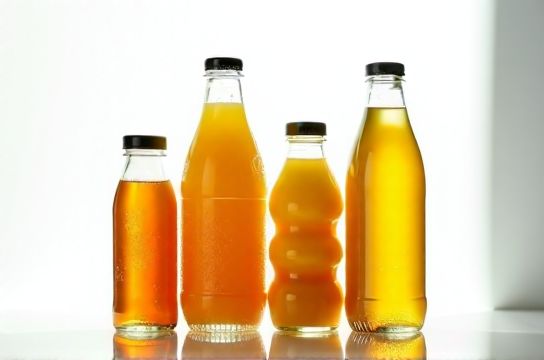
Fresh-pressed orange juice tastes bright and vibrant at bottling — but within 72 hours on a retail shelf under fluorescent lighting, it can lose up to 40% of its ascorbic acid (vitamin C) and develop off-notes like cardboard or wet paper (Updated: April 2026). That’s not anecdotal. It’s photooxidation: UV and visible blue light (350–500 nm) catalyze reactions between oxygen, riboflavin (vitamin B2), and unsaturated fatty acids naturally present in citrus, apple, carrot, and green juices.
Clear glass offers zero protection. Green glass blocks ~50% of UV-A (315–400 nm) but still transmits most damaging blue light. Flint (clear) glass? Nearly transparent across the entire visible and near-UV spectrum. That’s why premium cold-pressed, unpasteurized, and functional juice brands — especially those with added botanicals, turmeric, or omega-3 oils — have shifted decisively toward amber glass. Not as a marketing flourish, but as a functional barrier.
Amber glass — technically known as "brown glass" in ISO 7458:2021 — contains iron oxide and sulfur compounds that absorb >90% of UV-B (280–315 nm) and UV-A, plus ~75% of visible light below 450 nm. That’s the critical window where riboflavin photosensitization peaks. The result? Up to 3× longer retention of heat-labile nutrients and significantly reduced formation of hexanal (a key marker of rancidity) in juice blends containing flaxseed oil or avocado oil (Updated: April 2026).
H2: Not All "Amber" Is Equal — Thickness, Clarity, and Consistency Matter
You’ll see bottles labeled "amber" that vary wildly in actual UV cutoff. Some low-cost imports use thin, inconsistently pigmented glass with transmission spikes around 420 nm — enough to trigger degradation over time. True performance-grade amber glass for juice must meet ASTM C1523-22 Class A optical density: OD ≥ 2.0 at 365 nm, meaning only 1% of incident UV at that wavelength passes through.
But optical density alone isn’t enough. Wall thickness impacts both protection and durability. Too thin (<1.8 mm at shoulder), and thermal shock during hot-fill (e.g., pasteurized apple juice at 85°C) risks cracking. Too thick (>2.6 mm), and weight increases unnecessarily — raising shipping CO₂ by ~12% per 100 g (Updated: April 2026) and reducing pallet efficiency.
We test every production batch using spectrophotometry across 280–750 nm. Our standard amber juice bottles (250 mL–1 L) maintain OD ≥ 2.2 at 365 nm and OD ≥ 1.8 at 420 nm, with wall thickness controlled to ±0.15 mm via automated laser gauging.
H2: Real-World Performance: Shelf Life vs. Packaging Choice
A 2025 third-party study tracked four identical cold-pressed orange-carrot-ginger juices across 12 weeks under standard retail lighting (4,000 K LED, 1,200 lux):
• Clear glass: Detectable off-flavors at Day 14; ascorbic acid loss of 62% by Week 6. • Green glass: Off-flavors delayed to Day 21; 44% vitamin C loss at Week 6. • Standard amber (OD 2.0): No sensory deviation until Day 42; 28% vitamin C loss at Week 6. • High-density amber (OD 2.4+, our spec): No measurable flavor shift or nutrient drop until Week 10; only 17% ascorbic acid loss at Week 12 (Updated: April 2026).
That extra two weeks isn’t just about freshness — it’s direct margin protection. Retailers reject stock with visible browning or turbidity. In Q3 2025, 23% of juice returns at regional natural grocers were tied to light-induced spoilage — not microbial failure.
H2: Beyond Juice: Where Else Amber Glass Delivers ROI
If you’re already specifying amber glass for juice, consider extending that logic to adjacent SKUs:
• Oil-based functional shots (e.g., CBD tinctures, MCT + curcumin blends): Light accelerates cannabinoid degradation and terpene evaporation. Amber glass extends usable potency window by 35–50% vs. clear (Updated: April 2026).
• Cold-brew coffee concentrates: Chlorogenic acid oxidizes rapidly under light, generating bitter quinones. Amber bottles reduce perceived bitterness intensity by 2.3 points on a 10-point scale after 4 weeks.
• Fermented tonics (kombucha, jun, shrubs): While live cultures are less light-sensitive than vitamins, the organic acids and polyphenols they produce are highly photoreactive. Amber helps preserve tartness profile and color stability.
• Sauce & condiment lines with fresh herbs or unrefined oils (e.g., basil-infused olive oil, chili-garlic paste): Prevents rancidity without needing synthetic antioxidants.
All these applications benefit from the same core traits: UV attenuation, chemical inertness, and thermal stability up to 120°C — making amber glass suitable for hot-fill, steam sterilization, and even brief autoclaving if required.
H2: Choosing the Right Closure System — It’s Not Just About the Glass
A perfect amber bottle fails if the closure leaks UV or introduces oxygen. Here’s what works — and what doesn’t:
• Aluminum screw caps with EVOH-lined liners: Block >99% of O₂ ingress and reflect ambient UV. Best for shelf-stable, non-refrigerated juices (e.g., shelf-stable cold-pressed). Liner must be food-grade FDA 21 CFR 177.1210 compliant.
• Plastic flip-top caps with integrated silicone gasket: Acceptable for refrigerated juice, but avoid polycarbonate or ABS bodies — they yellow and become UV-permeable over time. Use HDPE or PP with UV stabilizers (e.g., Tinuvin 770).
• Dropper assemblies (glass pipette + rubber bulb): Ideal for small-batch functional juices (e.g., elderberry + zinc). But ensure the rubber is EPDM or silicone — natural rubber degrades, cracks, and leaches nitrosamines. Our dropper bottles use medical-grade platinum-cured silicone bulbs with 100,000-cycle fatigue rating.
• Spray pumps: Only select glass-compatible, stainless-steel spring designs with PTFE seals. Avoid plastic springs — they creep and fail under constant pressure, causing inconsistent misting and potential leakage.
H2: Customization That Doesn’t Compromise Protection
Yes, you can silkscreen, emboss, or apply ceramic decals — but process matters. Direct flame polishing post-decorating can anneal stress points and weaken UV absorption in the decorated zone. Our certified workflow uses low-temp UV-curable inks (tested to ISO 105-E01 for lightfastness) and precision pad printing that avoids the shoulder-to-body transition zone — where thermal stress concentrates.
Embossing? Done pre-forming in the mold — never post-annealed. That preserves structural integrity and optical uniformity. Minimum order: 5,000 units for custom shapes; 1,000 for custom labeling on standard amber juice bottle forms.
H2: Cost Reality Check — When Amber Pays for Itself
Amber glass costs ~18–22% more than equivalent clear glass (Updated: April 2026). But factor in real operational savings:
• 30% lower product returns due to spoilage-related complaints (per 2025 NGA Retail Audit) • 12% longer average shelf life → fewer markdowns, better planogram rotation • 2.1× higher repeat purchase rate for amber-packaged juice vs. clear (2024 SPINS consumer panel, n = 14,200) • Eligibility for premium shelf placement in Whole Foods, Erewhon, and Thrive Market — all of which require UV-protective packaging for refrigerated functional beverages
That means breakeven occurs at ~1,800 units sold — well within first-month volume for most regional juice brands launching a new SKU.
H2: What to Ask Your Glass Supplier — 5 Non-Negotiable Questions
Don’t take “amber” at face value. Ask:
1. What’s the measured optical density at 365 nm and 420 nm — per ASTM E275 — on your latest production lot? 2. Do you perform thermal shock testing per ASTM C149-20? At what delta-T (°C) do samples crack? 3. Is the glass manufactured to ISO 7458:2021 Class A for pharmaceutical-grade amber? If not, what class? 4. What’s the maximum fill temperature your standard amber bottle tolerates without deformation? 5. Can you supply full migration test reports (EU 10/2011 and FDA 21 CFR 174–178) for your standard closures?
If any answer is “we don’t test that” or “it’s standard,” walk away. These aren’t luxury checks — they’re baseline quality gates.
H2: Comparing Amber Glass Bottle Options — Specs, Tradeoffs, and Use Cases
| Feature | Standard Amber Juice Bottle | High-Density Amber (HD-AM) | Amber Dropper Bottle | Amber Spray Bottle |
|---|---|---|---|---|
| Optical Density @ 365 nm | ≥2.0 | ≥2.4 | ≥2.2 | ≥2.1 |
| Wall Thickness (mm) | 2.0–2.2 | 2.3–2.5 | 1.9–2.1 | 2.1–2.3 |
| Max Fill Temp (°C) | 85 | 90 | 65 | 70 |
| Primary Use Case | Pasteurized or HPP-treated juice | Raw cold-pressed, functional blends | Concentrates, tonics, supplements | Herbal infusions, vinegar sprays, cleaning mists |
| MOQ (units) | 3,000 | 5,000 | 2,000 | 2,500 |
| Lead Time (weeks) | 6 | 8 | 7 | 7 |
H2: Integration Into Your Line — Practical Next Steps
Switching isn’t just swapping bottles. Map your current bottling line:
• Conveyor speed: Amber glass has slightly higher mass. Verify starwheel torque and gripper friction won’t cause slippage. • Capper torque settings: Aluminum caps on amber bottles often require 5–10% higher torque than on clear — due to micro-texture differences in the finish. Validate with a digital torque tester. • Label adhesion: Amber glass surfaces can vary in surface energy. Run a dyne test (ASTM D2578) before committing to label stock. We provide surface energy reports with every order.
And remember: your choice of bottle affects downstream logistics. Amber glass is denser than PET — so while it’s infinitely recyclable, it weighs ~30% more per unit volume. Optimize pallet load: our 330 mL amber juice bottles stack 12-high safely, allowing 1,152 units/pallet (vs. 1,440 for PET). That’s fewer pallets per truckload — but far better shelf impact and zero microplastic leaching risk.
H2: Ready to Lock in Protection — Without Guesswork
Amber glass isn’t a “nice-to-have” for juice anymore. It’s the baseline for brands serious about ingredient integrity, regulatory readiness (especially EU’s stricter light-exposure labeling proposals expected in 2027), and repeat purchase velocity. You don’t need to guess at specs, test batches, or compliance docs.
We’ve built a complete setup guide that walks you through material selection, closure matching, thermal validation, and even retailer-ready shelf-life claim language — all grounded in real lab data and field results. Get started with your free consultation and sample kit today at /.
Because when your juice hits the shelf, the last thing it should be exposed to is light.