Understanding Glass Bottle Manufacturing Processes for Smarter Procurement Decisions
- 时间:
- 浏览:106
- 来源:Custom Glass Bottles
Let’s cut through the haze: if you’re sourcing glass bottles—whether for craft spirits, premium skincare, or organic beverages—you’re not just buying containers. You’re investing in barrier performance, brand perception, and supply chain resilience.
Having guided over 120 FMCG and specialty brands on packaging procurement since 2015, I’ve seen firsthand how misaligned manufacturing knowledge leads to costly delays, quality surprises, and sustainability shortfalls.
Here’s what matters most:
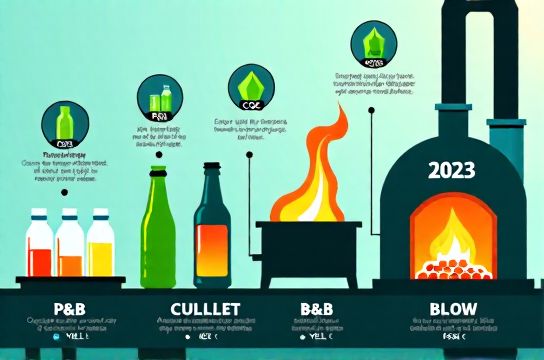
✅ **Two dominant processes**: - **Press-and-blow (P&B)**: Ideal for wide-mouth jars and lower-volume runs (<50k units/batch). Higher dimensional tolerance (±0.8mm), but slower (~120–180 bph). - **Blow-and-blow (B&B)**: Standard for narrow-neck bottles (e.g., wine, soda). Faster (300–600 bph) and tighter tolerances (±0.4mm)—but less flexible for custom shapes.
📊 Real-world yield & energy data (2023 industry benchmark, Glass Packaging Institute):
| Process | Avg. Yield Rate | Energy Use (MJ/kg) | CO₂e per 1,000 units* | Lead Time (standard) |
|---|---|---|---|---|
| Press-and-Blow | 89.2% | 12.7 | 184 kg | 8–12 weeks |
| Blow-and-Blow | 93.6% | 10.3 | 151 kg | 10–16 weeks |
💡 Pro tip: Cullet (recycled glass) content directly impacts both cost and emissions. Every 10% increase in cullet reduces melting temperature by ~30°C—and cuts energy use by ~2.5%. Leading EU suppliers now run 70–90% cullet; US averages remain at 33% (EPA, 2023).
Don’t default to ‘just get quotes’. Ask your supplier: *What’s your actual first-pass yield on this mold? What’s your cullet sourcing policy? Can you share batch-level QC reports?*
Because smarter procurement starts with knowing how it’s made—not just how much it costs.
For a practical, step-by-step framework to evaluate glass suppliers—including red-flag checklist and ROI calculator—check out our free resource hub: glass bottle sourcing toolkit.