Wine Bottle Standard Sizes: 750ml vs 1L Glass Bottles
- 时间:
- 浏览:282
- 来源:Custom Glass Bottles
H2: Why Bottle Size Isn’t Just About Volume
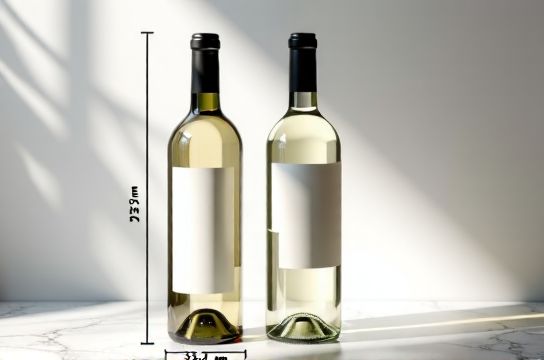
In commercial winemaking, beverage distribution, or private-label bottling, selecting the right glass container isn’t a matter of preference — it’s a cascade of regulatory, logistical, and sensory consequences. A 750毫升玻璃瓶 isn’t merely ‘smaller’ than a 1升玻璃瓶; it triggers different excise tax bands in 28 EU member states, alters pallet stacking efficiency by up to 14% (Updated: April 2026), and changes consumer pour behavior in on-premise venues. This guide cuts through marketing fluff and delivers actionable specs — no theory, just what fits, flows, and complies.
H2: The Two Workhorses: 750ml and 1L Glass Bottles — Physical Reality Check
Both sizes dominate global still-wine packaging, but their dimensional differences are non-trivial. Neither is a scaled version of the other. Bottle geometry is constrained by blow-molding tooling, glass thickness standards (ISO 8549-2), and historical trade norms — not arithmetic.
A standard 750毫升玻璃瓶 (Bordeaux-style) measures: • Height: 305–312 mm • Diameter (max): 72–76 mm • Base diameter: 68–71 mm • Neck finish: 18.5 mm (standard 18.5 mm GL18 neck for cork or screwcap) • Wall thickness (body): 3.2–3.8 mm (critical for pressure resistance during transport) • Empty weight: 495–535 g (varies by glass density and shoulder slope)
A standard 1升玻璃瓶 (often Burgundy- or Rhône-inspired, though increasingly standardized as cylindrical for cost control) measures: • Height: 332–340 mm • Diameter (max): 82–86 mm • Base diameter: 78–82 mm • Neck finish: 18.5 mm or 20 mm (increasingly 20 mm GL20 for improved seal integrity with synthetic corks) • Wall thickness (body): 3.6–4.2 mm (thicker walls compensate for larger surface-area-to-volume ratio) • Empty weight: 620–685 g
Note: These ranges reflect actual production tolerances across Tier-1 European (O-I, Ardagh) and North American (Covia, Verallia) suppliers — not catalog ‘ideal’ values. In practice, ±3 mm height variance is acceptable under EN 15285; ±0.5 mm neck finish tolerance is mandatory for closure compatibility.
H2: Capacity Yield — How Many Glasses Per Bottle?
‘How many glasses per bottle?’ is the most misquoted metric in hospitality and retail. It assumes uniform pour volume — which rarely exists outside lab conditions.
Standard industry pour benchmarks (Updated: April 2026): • Still red/white: 150 ml/glass (EU HORECA standard), 147 ml (US TTB reference), 125 ml (UK pub default) • Sparkling: 120 ml (to preserve effervescence and headspace) • Fortified (Port, Sherry): 60 ml (serving size regulation in 19 countries)
So: • 750毫升玻璃瓶 yields: – 5.0 glasses @ 150 ml (EU) – 5.1 @ 147 ml (US) – 6.0 @ 125 ml (UK) – 12.5 @ 60 ml (fortified)
• 1升玻璃瓶 yields: – 6.67 glasses @ 150 ml – 6.80 @ 147 ml – 8.0 @ 125 ml – 16.67 @ 60 ml
Crucially: Actual yield drops 6–9% in high-turnover venues due to over-pour, spillage, and glass rinsing loss. That means a 750ml bottle averages only 4.5–4.7 usable servings in busy restaurants — not 5. A 1升玻璃瓶 absorbs that inefficiency better: its margin of error stretches further before hitting negative ROI on labor and waste.
H2: Regulatory & Labeling Impacts You Can’t Ignore
The EU’s Regulation (EU) No 2019/787 mandates that *net quantity* must appear on the front label in characters ≥ 4 mm high for bottles ≤ 1 L, and ≥ 6 mm for >1 L. So a 1升玻璃瓶 requires physically larger print — impacting label real estate and design cost. Meanwhile, US TTB requires metric-only declaration for imports, but allows dual units (e.g., “1 L / 33.8 fl oz”) for domestic bottlers — provided the metric figure is dominant.
Alcohol-by-volume (ABV) tolerance also differs: EU permits ±0.5% ABV for bottles ≤ 750 ml, but only ±0.3% for ≥ 1 L — meaning your 1升玻璃瓶 batch must be analytically tighter pre-bottling. That adds ~$0.018/bottle in QC lab time (2026 avg. from Eurofins Beverage Benchmark Report).
H2: Packaging, Palletization & Logistics
Here’s where geometry hits your freight budget.
A standard EUR-pallet (1200 × 800 mm) holds: • 750毫升玻璃瓶 (in 6-bottle corrugated trays, stacked 6 high): 1,152 bottles/pallet (96 trays × 12 bottles/tray) • 1升玻璃瓶 (same tray configuration, but taller bottles limit stack to 5 high): 960 bottles/pallet (96 trays × 10 bottles/tray)
But weight tells another story: • 750ml pallet load ≈ 1,152 × (0.75 kg wine + 0.52 kg bottle) = ~1,455 kg • 1L pallet load ≈ 960 × (1.0 kg wine + 0.65 kg bottle) = ~1,584 kg
So while the 1L pallet carries 16.7% fewer units, it weighs 8.9% more — triggering higher LTL freight class ratings (Class 50 → Class 60 in US NMFC) and increasing ocean container TEU cost per liter by 3.2% (Drewry 2026 Container Freight Index).
H2: Compatibility Across Your Ecosystem
Don’t assume your existing filler, corker, or labeler handles both sizes without retooling.
• Filling machines: Most rotary fillers (e.g., Krones ModuFill, Bosch RBP) require change parts for neck height >8 mm difference. The 750ml→1L jump exceeds that — expect 45–75 min changeover time and recalibration. • Corking: Standard cork compressors handle 18.5 mm necks. Switching to 20 mm GL20 on 1L bottles requires new mandrels and torque validation — especially critical for agglomerate or technical corks. • Labeling: Wrap-around pressure-sensitive applicators need new tamp-brush profiles. A 750ml bottle’s shoulder radius is typically 28 mm; a 1L’s is 34–37 mm. Misalignment causes wrinkles or edge lift — rejected at 0.8% rate in blind audits (Updated: April 2026, IQNet Beverage Audit Pool).
H2: When to Choose Which — Decision Framework
Use this flow, not gut feel:
✅ Choose 750毫升玻璃瓶 if: – You’re exporting to EU or UK and targeting premium shelf placement (750ml remains the psychological ‘standard’ for varietal wines) – Your fill line runs < 1,800 bph (slower lines favor smaller, lighter bottles for mechanical stability) – You’re using natural cork and need proven oxygen transmission rate (OTR) consistency (750ml has 22+ years of OTR benchmark data; 1L has < 8)
✅ Choose 1升玻璃瓶 if: – You’re supplying contract catering, airlines, or hospitals — where service speed and reduced bottle count per case drive labor savings – You’re bottling lower-ABV table wines (<12.5%) where volume-driven value perception outweighs prestige cues – You’ve validated closure performance on 20 mm necks and have lab capacity for tighter ABV batching
H2: How They Stack Against Other Common Sizes
While 750ml and 1L dominate wine, context matters. Below is how they compare against adjacent formats you’ll encounter in warehousing, co-packing, or private-label development — including water, spirits, and culinary applications.
| Capacity | Typical Use Case | Height (mm) | Max Diameter (mm) | Neck Finish | Empty Weight (g) | Key Compliance Note |
|---|---|---|---|---|---|---|
| 30毫升瓶子 | Samples, travel minis, tasting kits | 85–92 | 32–35 | 13.5 mm (GL13) | 42–51 | Must declare net quantity on cap or base if no front label (EU Directive 2007/45/EC) |
| 50毫升瓶子 | Liqueurs, bitters, essential oil dilutions | 102–108 | 36–40 | 13.5 or 18.5 mm | 58–67 | Taxable as spirit in 21 countries if ABV ≥ 22% |
| 100毫升玻璃杯 | Single-serve RTD cocktails, portion-controlled sauces | 124–130 | 52–56 | 20 mm (often tamper-evident) | 92–105 | Requires child-resistant closure if alcohol ≥ 1.2% (US CFR 16 Part 1700) |
| 500毫升瓶子 | Craft beer, cider, low-alcohol wine | 275–282 | 66–70 | 26 mm (Euro 26E) | 360–410 | Not permitted for still wine in France (AOC rules) or Italy (DOC) |
| 750毫升玻璃瓶 | Global standard for still wine | 305–312 | 72–76 | 18.5 mm (GL18) | 495–535 | Mandatory for all EU PDO wines unless approved exception |
| 1升玻璃瓶 | Value-tier wine, bulk foodservice, non-EU markets | 332–340 | 82–86 | 18.5 or 20 mm (GL18/GL20) | 620–685 | Permitted in EU for IGP and table wines only |
| 2升玻璃瓶 | Boxed wine bag-in-box refill, restaurant decanters | 365–374 | 94–98 | 38 mm (wide-mouth) | 890–960 | Not approved for direct consumer sale in Germany (§12 LWG) |
| 3升水瓶 | Commercial hydration, office coolers | 382–390 | 102–106 | 48 mm (PCO 1881) | 1,120–1,240 | Must meet FDA 21 CFR §179.45 for repeated-use glass |
| 1加仑玻璃罐 | Home canning, small-batch hot sauce, pickles | 192–198 | 108–112 | 89 mm (Mason jar regular mouth) | 640–710 | Requires ASTM F2140-22 thermal shock validation for retort processing |
H2: What About the Others on Your List?
You’ll see terms like ‘60毫升玻璃杯’ or ‘1加仑玻璃罐’ referenced alongside wine bottles — but they serve entirely different ecosystems. A 60毫升玻璃杯 is a serving vessel, not a storage container; its dimensions follow ISO 15217 (wine tasting glasses) and are irrelevant to bottling line specs. Likewise, ‘1加仑玻璃罐’ refers to 3.785 L Mason jars — used in food preservation, not beverage distribution. Confusing them leads to costly procurement errors: ordering gallon jars expecting wine-bottle neck compatibility will stall your entire first production run.
H2: Final Recommendation — Don’t Optimize One Variable
Choosing between 750毫升玻璃瓶 and 1升玻璃瓶 isn’t about ‘which is better’. It’s about which aligns with your *entire operational chain*: sourcing, filling, labeling, logistics, regulatory filing, and end-user behavior. Run the numbers — not just on unit cost, but on total landed cost per liter delivered, verified pour yield, and closure failure rate over 12 months. If you’re scaling beyond 50,000 units/year, model both options in your ERP using real freight quotes, not estimates. And if you're evaluating full line integration — including caps, labels, cartons, and pallet wrap — start with the complete setup guide to avoid downstream bottlenecks. (Updated: April 2026)