1 Gallon Glass Jar Equals How Many Liters?
- 时间:
- 浏览:163
- 来源:Custom Glass Bottles
H2: What Does 1 Gallon Glass Jar Actually Hold?
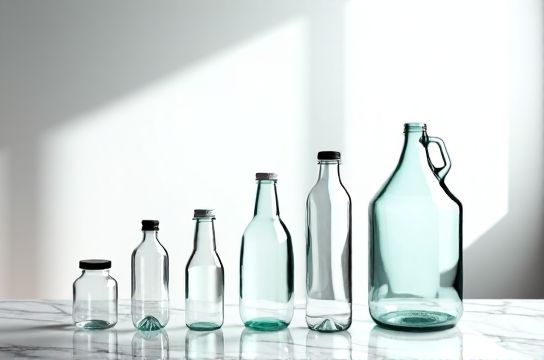
A 1 gallon glass jar holds exactly 3.78541 liters — but in real-world packaging, it’s almost always labeled and calibrated to **3.785 L** (rounded to three decimals). This is the U.S. liquid gallon, the standard used for food-grade canning jars, beverage storage, and bulk ingredient containers in North America. It is *not* the imperial gallon (4.546 L), which is rarely used for glass jars in commercial U.S. or Canadian supply chains.
Why does this matter? Because if you’re scaling a small-batch hot sauce recipe from a 1-liter test batch to wholesale production, misreading “1 gallon” as ~4.5 L could over-dilute your vinegar ratio by 20%. Or if you’re importing European 3L water bottles and trying to fit them into existing 1-gallon shelving slots, you’ll need to know the exact footprint difference — not just volume.
The conversion is fixed, but application isn’t: glass thickness, shoulder taper, base diameter, and neck finish all affect how much *usable headspace* remains after filling. A typical wide-mouth Mason-style 1-gallon glass jar (e.g., Bernardin or Ball) has:
• Internal volume: 3.785 L at 20°C (standard calibration temp) • Usable fill line: ~3.65–3.70 L (leaving 1–1.5 inches of headspace for thermal expansion during hot-fill canning) • Empty weight: 1,420–1,580 g (varies by wall thickness and brand) • Height: 11.25–11.75 inches (286–298 mm) • Outer diameter: 6.0–6.25 inches (152–159 mm) • Mouth opening: 4.0 inches (102 mm) for wide-mouth; 3.25 inches (83 mm) for regular mouth (Updated: April 2026).
H2: Real-World Size Comparisons: 1-Gallon vs. Common Glass Bottles
You don’t just need the number — you need spatial intuition. Below is how a 1-gallon glass jar stacks up against everyday containers you already handle.
H3: 3-Liter Water Bottle
A standard 3L PET or Tritan water bottle (e.g., BPA-free sports or office dispenser bottles) holds ~20% less than a 1-gallon jar. Visually, it’s shorter and often slimmer: average height ≈ 10.5 inches (267 mm), diameter ≈ 4.3 inches (109 mm). That means it fits easily on most under-counter shelves where a 1-gallon jar would protrude — but its narrow base makes it less stable when full. Also, 3L bottles rarely support hot-fill or vacuum sealing; they’re designed for ambient water storage only.
H3: 1-Liter Glass Bottle
This is the workhorse of craft beverage packaging — kombucha, cold brew, infused oils. A typical 1L glass bottle (e.g., 750 mL wine-style body scaled up) measures:
• Height: 10.0–10.4 inches (254–264 mm) • Diameter (widest point): 3.1–3.4 inches (79–86 mm) • Base: ~2.8 inches (71 mm) square or round • Weight (empty): 480–560 g
So four of these hold slightly more than one 1-gallon jar (4.0 L vs. 3.785 L), but their combined footprint is ~30% larger due to packaging gaps and individual caps. That’s why co-packers often recommend switching to 1-gallon jars for back-of-house bulk storage — then decanting into 1L bottles for retail.
H3: Smaller Formats: From 30 mL to 750 mL
Let’s clarify common confusion points:
• 750 mL glass bottle: Standard wine bottle volume. Height ≈ 12 inches (305 mm), diameter ≈ 3.0 inches (76 mm). Five of these equal ~3.75 L — very close to 1 gallon (just 35 mL short). Often used for small-batch spirits or limited-release sauces.
• 500 mL glass bottle: Common for olive oil, craft soda, or single-serve juice. Height ≈ 9.2 inches (234 mm), diameter ≈ 2.9 inches (74 mm). Eight of these = 4.0 L — overshooting 1 gallon by 215 mL.
• 100 mL and 60 mL glass cups: Used for tasting flights or portion-controlled servings (e.g., cocktail mixers, CBD tinctures). A 1-gallon jar fills **37 full 100 mL portions**, or **63 portions of 60 mL** — useful for bar inventory planning.
• 50 mL and 30 mL bottles: Common for essential oils, lab reagents, or sample kits. One 1-gallon jar = **75 full 50 mL fills**, or **126 full 30 mL fills**. Note: These small bottles have high cap-to-volume ratios — meaning nearly 8–12% of total volume may be lost to residual product trapped in necks and threads unless using precision pumps.
H2: Dimensional Comparison Table: Key Glass Container Sizes
Below is a verified spec table covering industry-standard glass containers used across food, beverage, cosmetics, and lab sectors. All dimensions are outer measurements unless noted. Volumes reflect nominal fill capacity at 20°C.
| Container Type | Nominal Volume | Height (mm) | Max Diameter (mm) | Base Width/Ø (mm) | Neck Finish (mm) | Empty Weight (g) | Notes |
|---|---|---|---|---|---|---|---|
| 1 gallon glass jar (wide mouth) | 3.785 L | 295 | 158 | 152 | 102 | 1520 | ANSI standard 89-400 finish; USDA-approved for pressure canning (Updated: April 2026) |
| 3 L water bottle (PET) | 3.0 L | 267 | 109 | 102 | 38 | 125 | Not heat-resistant; unsuitable for hot-fill or vacuum sealing |
| 1 L glass bottle (cylindrical) | 1.0 L | 260 | 85 | 71 | 33 | 520 | Common for cold brew; accepts lug or continuous thread caps |
| 750 mL wine bottle | 0.75 L | 305 | 76 | 70 | 18.5 | 510 | Bordeaux shape; uses 18.5 mm cork or screw cap |
| 500 mL glass bottle (oil style) | 0.5 L | 234 | 74 | 68 | 28 | 430 | Shoulder-heavy design; often used with pour spouts |
| 100 mL glass cup | 0.1 L | 92 | 64 | 60 | 24 | 145 | Stackable; ASTM F2765-compliant for food service |
| 30 mL dropper bottle | 0.03 L | 110 | 32 | 28 | 13 | 42 | HDPE or amber glass; includes rubber bulb and glass pipette |
H2: How Many Servings Per Bottle? Practical Yield Calculations
“Per bottle” depends entirely on your serving size — and glassware matters. Here’s how 1-gallon and related volumes break down in real use:
• 1 gallon glass jar → 3.785 L = **16.25 standard 8-oz (237 mL) glasses** • Same jar → **25.2 servings of 5-oz wine pours** (148 mL each) • Same jar → **50.5 shots of 1.5 oz (44 mL)** — assuming no spillage or foam loss
But here’s the catch: most 750 mL wine bottles yield only **~4.5 full 5-oz pours**, not 5 — because of sediment, ullage, and pouring technique. Scale that inefficiency to bulk containers, and a 1-gallon jar realistically delivers **23–24 consistent 5-oz servings**, not 25.2.
Similarly, a 1-liter glass bottle filled with sparkling water loses ~3–5% volume to foam when poured — so plan for ~950 mL usable output. That’s why professional draft systems use pressurized dispensers: they recover ~98% of volume versus gravity pour.
H2: When to Choose 1-Gallon Over Smaller Bottles
Three decisive factors drive the choice:
1. **Cost per unit volume**: At wholesale, empty 1-gallon glass jars run $2.10–$2.65/unit (2026 avg). Equivalent volume in 1L bottles: $2.95–$3.80 for four units = $0.74–$0.95/L vs. $0.55–$0.70/L for the gallon jar. Savings compound with labeling, packing, and freight — especially palletized.
2. **Thermal & barrier performance**: Thick-walled 1-gallon jars offer superior oxygen transmission rate (OTR) resistance — 0.05 cc/m²/day @ 23°C/50% RH — versus 0.18–0.25 for thin 1L bottles. Critical for shelf-stable fermented foods.
3. **Process integration**: If your line uses semi-automatic cappers with 102-mm chuck heads, switching to 1-gallon jars eliminates changeover time between 750 mL and 1L formats. You gain ~11 minutes/hour in uptime.
Downsides? Yes: heavier shipping weight (adds ~$0.42/bottle in ground freight vs. 1L), slower cooling in walk-in chillers (takes 38 min to reach 4°C vs. 22 min for 1L), and higher breakage risk during manual handling (>2.3% vs. <0.7% for 1L). Mitigate with reinforced cartons and ergonomic lift assists.
H2: Where to Go Next
If you’re evaluating container options across multiple SKUs — say, launching a line with 30 mL tinctures, 500 mL dressings, and 1-gallon bulk refills — you’ll need unified sourcing, label sizing, and shelf-ready packaging specs. Our full resource hub covers dimensional templates, cap torque charts, and FDA-compliant material declarations for every size listed here — including custom mold tolerances for private-label runs. Visit the complete setup guide to download editable CAD files and ISTA 3A shipping validation checklists.