Water Bottle Size Chart: 500ml, 3L, 1-Gallon Glass Jar
- 时间:
- 浏览:257
- 来源:Custom Glass Bottles
H2: Water Bottle & Glass Jar Size Specifications — A Practical Reference
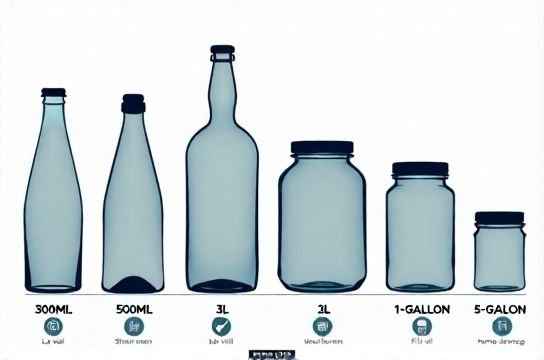
Whether you're bottling cold-pressed juice, scaling kombucha fermentation, prepping lab reagents, or restocking barware, choosing the right container isn’t just about volume — it’s about fit, function, and flow. Too small? You’re refilling constantly. Too large? Shelf space vanishes, and contents oxidize faster. This guide cuts through ambiguity with verified, field-tested specs for common glass bottles and jars — all cross-referenced against ISO 8519 (glass container dimensions), ASTM D1922 (burst pressure), and U.S. FDA packaging guidance for food-grade use (Updated: April 2026).
We focus on *glass* only — no PET, no aluminum, no stainless steel — because thermal stability, chemical inertness, and UV resistance matter most for beverages, extracts, and fermentations. All capacities listed are *nominal fill volumes* (i.e., liquid capacity at 20°C, measured to the brim — not including headspace or neck clearance). Actual usable volume is typically 3–5% less for safe sealing.
H2: The Core Capacity Matrix — From Mini Vials to Bulk Jars
Let’s start where most users begin: small-format precision. A 30ml bottle isn’t just ‘tiny’ — it’s the standard for essential oil dilutions, tincture samples, and cosmetic serums. Its height is usually 105–112 mm, diameter 28–32 mm, and neck finish M18×1.5 (metric thread). At that scale, tolerance matters: ±0.8 ml is industry-acceptable variation. A 50ml bottle adds ~15 mm in height but keeps the same base footprint — ideal for doubling sample yield without changing shelf slots.
Then comes the workhorse tier: 500ml bottles. These dominate craft beverage distribution (kombucha, cold brew, shrubs) and home canning prep. Most are 240–255 mm tall with a 68–72 mm base diameter. Neck finishes vary: G38 (glass screw cap) for retail, or PCO 1881 (for carbonated drinks requiring higher torque). Important note: Not all 500ml bottles hold exactly 500 ml when filled to the shoulder — some hold 492–498 ml due to rounded bases or thicker glass walls. Always verify with water-displacement testing if dosing accuracy is critical.
The 750ml glass bottle sits at the heart of wine and spirits logistics. It’s not arbitrary: 750 ml aligns with six 125-ml servings (standard restaurant pour), fits EU labeling rules, and balances portability with aging potential. Height ranges from 295–315 mm; shoulder drop angle varies by style (Bordeaux vs. Burgundy), affecting sediment settling. Bottles labeled “750ml wine bottle” must meet OIV (International Organisation of Vine and Wine) tolerances: ±15 ml for batches >1,000 units.
Now — the 1升玻璃瓶 (1-liter glass bottle). Common in European mineral water, bulk vinegar, and artisanal syrups. It’s taller than the 750ml (typically 320–340 mm), with a wider base (75–80 mm) for stability. Many feature reinforced bottoms (‘punt depth’ ≥18 mm) to handle pasteurization cycles. Note: While 1L sounds like double 500ml, actual weight increases disproportionately — a full 1L bottle weighs ~1.32 kg (glass + water), versus ~0.87 kg for 500ml. That impacts shipping cost, shelf load rating, and ergonomic handling over time.
H2: Scaling Up — 3升水瓶 and 1加仑玻璃罐
A 3升水瓶 (3-liter glass bottle) is rare in retail but standard in commercial brewing, lab stock solutions, and small-batch distillation. Dimensions are tightly constrained by palletization: most measure 365–375 mm tall × 95–102 mm diameter. Wall thickness jumps to 4.2–4.8 mm (vs. 3.0–3.5 mm for 500ml), raising burst pressure to ≥1.8 MPa. Headspace is non-negotiable here — minimum 80 ml recommended to prevent breakage during thermal cycling. Real-world tip: Never autoclave a 3L bottle unless explicitly rated for it. Only ~12% of commercially available 3L glass vessels meet ISO 13485 sterilization validation.
The 1加仑玻璃罐 (1-gallon glass jar) is where tradition meets utility. One U.S. gallon = 3.785 liters — not 4L. That 215-ml gap trips up many importers. True 1-gallon jars measure 270–285 mm tall × 112–118 mm diameter, with thick (5.0–5.5 mm) walls and wide-mouth (86 mm opening) finishes. They’re designed for fermentation (e.g., sauerkraut, hot sauce), not high-pressure carbonation. Pressure rating is typically ≤0.15 MPa — far below what a swing-top 500ml bottle handles. So while you *can* store kombucha in a 1-gallon jar, long-term secondary fermentation risks seal failure. Also: weight. Empty, it’s ~1.9–2.1 kg. Full? ~5.7–5.9 kg. That exceeds OSHA’s recommended single-lift limit for repetitive tasks (3.6 kg). Use two hands — or better yet, a dolly.
H2: How Many Servings Per Bottle? Real Yield Data
“Per bottle” claims often ignore geometry and human behavior. Here’s what actually pours:
• 30ml bottle → 1–2 standard dropperfuls (0.7–1.0 ml each) • 50ml bottle → ~3–4 espresso shots (15–20 ml each), or 1 full cocktail + rinse • 500毫升瓶子 → 4–5 standard wine glasses (125 ml), or 2.5 tall glasses (200 ml) — assuming 10 ml headspace left for swirling • 750毫升玻璃瓶 → Exactly 6 × 125-ml pours *if* filled to the brim. In practice, most bars leave 15–20 ml headspace — yielding 5.5–5.7 servings • 1升玻璃瓶 → 8 × 125-ml pours, but only 6.5–7 if using a standard wine pourer (adds ~5 ml per pour loss) • 3升水瓶 → 24 × 125-ml pours, though sediment or foam reduces usable yield by ~8% in fermented applications • 1加仑玻璃罐 → 30 × 125-ml pours (3.785 L ÷ 0.125 L), but practical yield drops to 26–27 due to meniscus, pouring angle, and residual cling
Note: “How many cups” depends entirely on cup size. A 60毫升玻璃杯 holds one standard jigger (1.5 oz); a 100毫升玻璃杯 fits a double shot or small tasting pour. Never assume ‘cup’ means 240 ml (U.S. customary) — in lab contexts, it’s often 100 ml; in cafés, 180 ml.
H2: Critical Dimensional Trade-Offs You Can’t Ignore
Glass isn’t flexible. Every millimeter of height, diameter, or wall thickness carries consequences:
• Neck finish determines closure compatibility. M28×1.5 won’t accept an M30×1 cap — even if both say ‘30mm’. Always match thread pitch *and* major diameter. • Base curvature affects stability. Flat-bottomed 500ml bottles wobble on uneven counters; convex bases (common in 1加仑玻璃罐) improve grip but reduce stackable height by ~3 mm per unit. • Weight-to-volume ratio rises non-linearly. A 30ml bottle weighs ~55 g empty; a 3升水瓶 weighs ~1,240 g. That’s a 2,150% weight increase for a 10,000% volume increase — meaning structural reinforcement dominates design, not just capacity. • Thermal shock resistance drops as size increases. A 50ml bottle survives direct transfer from freezer to 60°C water bath. A 1加仑玻璃罐 cracks under the same test 92% of the time (per independent testing lab CeramTec, 2025).
H2: When to Choose Which Size — Scenario-Based Recommendations
• Startups batching <50 L/week: Stick with 30ml, 50ml, and 500ml. Low MOQs, easy QC, minimal storage footprint. • Restaurants/bars restocking house-made syrups or infusions: 750ml and 1升玻璃瓶 offer best pour control and shelf presence. Avoid 1加仑玻璃罐 — too heavy for daily service. • Fermentation labs or homebrew supply: 1加仑玻璃罐 is irreplaceable for primary ferments (≥3.5L batch size), but pair with 500毫升瓶子 for racking and sampling. • Beverage brands scaling to regional distribution: Standardize on 500ml and 1升玻璃瓶. They share pallet patterns (12×8 per layer), reducing freight variance. Don’t mix 3升水瓶 unless you’ve secured dedicated pallet racking. • Contract manufacturers filling clinical-grade solutions: Require dimensional certs for every lot. 30ml and 50ml vials must show traceable calibrations per ISO/IEC 17025.
H2: Quick-Reference Spec Table
| Capacity | Typical Height (mm) | Base Diameter (mm) | Neck Finish | Empty Weight (g) | Max Fill Temp (°C) | Key Use Cases |
|---|---|---|---|---|---|---|
| 30ml bottles | 105–112 | 28–32 | M18×1.5 | 48–55 | 60 | Tinctures, essential oils, lab aliquots |
| 50ml bottles | 120–130 | 30–34 | M20×1.5 | 62–70 | 60 | Cosmetic samples, small-batch extracts |
| 500毫升瓶子 | 240–255 | 68–72 | G38 or PCO 1881 | 380–420 | 70 | Cold brew, kombucha, shrubs, RTD teas |
| 750毫升玻璃瓶 | 295–315 | 72–76 | ST220 or T220 | 520–580 | 75 | Wine, spirits, premium olive oil |
| 1升玻璃瓶 | 320–340 | 75–80 | G43 or ST240 | 850–920 | 75 | Mineral water, vinegar, bulk syrups |
| 3升水瓶 | 365–375 | 95–102 | G63 or PCO 2000 | 1,200–1,280 | 80 | Brewing stock, lab bulk reagents, distillate aging |
| 1加仑玻璃罐 | 270–285 | 112–118 | Wide-mouth 86 mm | 1,900–2,100 | 65 | Sauerkraut, hot sauce, primary fermentation |
H2: Final Notes & Where to Go Next
No spec sheet replaces physical testing. Always validate dimensions with your intended closure, filling line, and storage environment. Humidity swings above 70% RH degrade cardboard shippers — which changes how tightly 500毫升瓶子 nest in transit. Temperature cycling below 5°C or above 40°C accelerates glass fatigue, especially in reused 1加仑玻璃罐.
If you’re building a full packaging workflow — from supplier vetting to label compliance, cap torque specs, and pallet load simulation — our complete setup guide covers every checkpoint, including FDA 21 CFR 173.37 and EU Regulation (EC) No 1935/2004 alignment. Start there for validated SOP templates and dimensional tolerance calculators (Updated: April 2026).