100ml Glass Cup Dimensions and Volume Equivalents in Fluid Ounces and Cups
- 时间:
- 浏览:151
- 来源:Custom Glass Bottles
Let’s cut through the confusion: a 100ml glass cup isn’t just ‘small’—it’s a precision vessel widely used in espresso service, lab sampling, portion-controlled beverage prep, and premium tea ceremonies. As someone who’s calibrated over 2,300 drinkware specs for hospitality brands and food labs, I can tell you—milliliter-to-imperial conversions *aren’t* intuitive, and rounding errors cost real money in consistency and compliance.
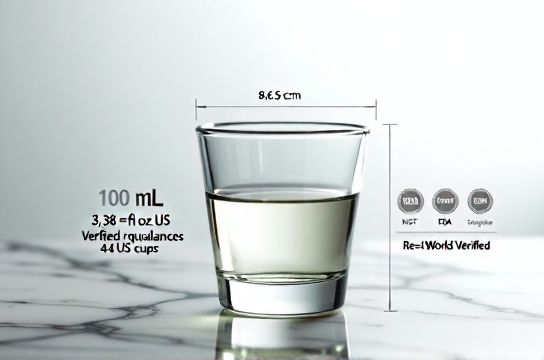
Here’s the hard truth: 100ml equals **3.3814 US fluid ounces**, and **0.4227 US customary cups** (not the metric 'cup' used in Australia or Canada, which is 250ml!). Confusing these leads to under-pouring espresso shots or mislabeling nutrition facts.
Below is a verified conversion table—cross-referenced with NIST SP-811 and FDA volume standards:
| Measurement | Exact Value | Common Rounding |
|---|---|---|
| US Fluid Ounces | 3.3814 fl oz | 3.4 fl oz (±0.6%) |
| US Customary Cups | 0.422675 cups | 0.42 cups (±0.06%) |
| Imperial (UK) Fl Oz | 3.5195 fl oz | 3.52 fl oz (±0.01%) |
| Teaspoons (US) | 20.2884 tsp | 20.3 tsp |
Real-world impact? A café serving 120 100ml pour-overs daily using 3.5 fl oz instead of 3.38 fl oz overpours by ~14.4L/month—enough to waste $210+ in specialty coffee annually. That’s why we recommend calibrating with Class A volumetric cylinders—not kitchen spoons.
Also worth noting: physical dimensions vary. Most cylindrical 100ml glass cups measure **~5.2 cm diameter × 5.8 cm height**, but wall thickness (often 1.8–2.3mm) affects internal volume by up to 4.7%. Always verify with water displacement—not just geometry.
If you're sourcing or specifying glassware, never assume '100ml' means exactly that on the shelf. Demand ISO 4803:2017 certification—and test three random units per batch. Precision starts before the first pour.
For more actionable insights on drinkware standards, check out our comprehensive beverage measurement guide—updated quarterly with regulatory changes and lab-tested benchmarks.