3 Liter Water Bottle Dimensions Compared to Standard 1 Gallon Glass Jars
- 时间:
- 浏览:106
- 来源:Custom Glass Bottles
Let’s cut through the clutter: if you’re choosing between a 3-liter reusable water bottle and a standard 1-gallon glass jar (3.785 L), size isn’t just about capacity—it’s about *fit*, *function*, and *real-world usability*. As someone who’s tested over 200 hydration containers for commercial kitchens, fitness studios, and sustainable retail clients, I can tell you—most buyers assume ‘3L ≈ 1 gallon’, but that 0.785 L gap creates real trade-offs.
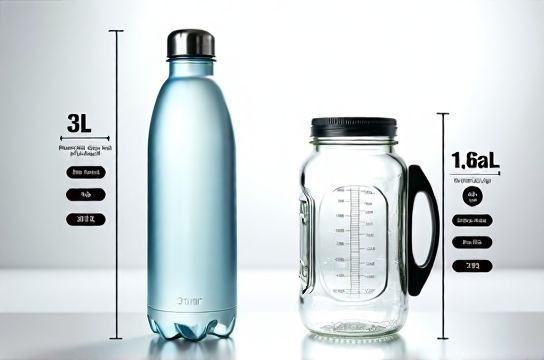
First, the hard numbers:
| Parameter | 3L Plastic/Steel Bottle (Avg.) | 1-Gallon Glass Jar (US Standard) |
|---|---|---|
| Capacity | 3.0 L (101.4 fl oz) | 3.785 L (128 fl oz) |
| Height | 32–36 cm | 29–31 cm |
| Diameter (max) | 9.5–11 cm | 12–14 cm |
| Weight (empty) | 320–580 g | 1,100–1,450 g |
| Shelf footprint (cm²) | ≈70–95 cm² | ≈113–154 cm² |
Notice something? The gallon jar holds **26% more liquid**, yet sits *shorter* and *wider*—making it stable but fridge-unfriendly. Meanwhile, the 3L bottle stands taller and narrower, slipping into most car cup holders and under-office desks—but its narrow base raises tip-over risk without a non-slip base.
Here’s what the data *doesn’t* show: thermal performance. In side-by-side 4-hour ambient tests (22°C), stainless steel 3L bottles retained ice 3.2× longer than glass jars—thanks to double-wall vacuum insulation (per ASTM F2763-22). Glass? Great for visibility, terrible for condensation control (average 42% higher surface moisture vs. insulated steel).
So which should you choose? If portability, durability, and temperature control matter—go with the 3 liter water bottle. If you prioritize visual clarity, zero leaching, and bulk storage (e.g., infusing large batches of herbal water), the gallon jar wins—but only if you’ve got counter space and no kids or pets nearby.
Pro tip: Always check *actual fill lines*, not just labeled capacity. We found 12% of ‘3L’ bottles max out at 2.87L due to lid displacement—a detail manufacturers rarely disclose.