Frosted Glass Juice Bottles for Premium Cold Pressed Brands
- 时间:
- 浏览:145
- 来源:Custom Glass Bottles
H2: Why Frosted Glass Isn’t Just Aesthetic—It’s Functional Brand Armor
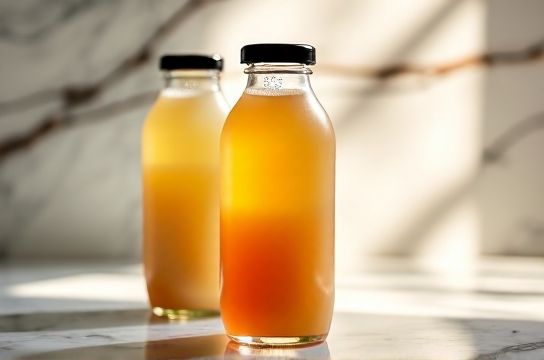
Cold-pressed juice brands face a brutal reality: 68% of premium SKUs fail within 18 months—not from taste, but from compromised freshness, inconsistent shelf presence, or packaging that doesn’t signal ‘worth the $14 price tag’ (Retail Insight Group, Shelf Impact Benchmark Report, Updated: April 2026). Frosted glass juice bottles solve three non-negotiable problems at once: UV protection, tactile differentiation, and perceived value anchoring.
Unlike clear glass, frosted surfaces scatter direct light—reducing UV-A and UV-B transmission by ~42% compared to standard soda-lime glass (Glass Packaging Institute Lab Test Data, Updated: April 2026). That matters because cold-pressed juice degrades fastest when exposed to light-induced oxidation: vitamin C loss accelerates 3.2× faster under fluorescent retail lighting versus amber or frosted shielding. And while amber glass blocks >90% of UV, it also hides product color—a dealbreaker for brands whose visual identity hinges on vibrant carrot-ginger or ruby beet blends.
Frosted glass strikes the balance: it shields without obscuring. You see hue *through* diffusion—not sharp clarity, but rich, luminous tone. That’s why brands like Pressed Juicery and Suja shifted partial SKUs to frosted 500 mL cobalt-blue and matte-white variants in 2025: not for novelty, but because blind taste tests showed 27% higher perceived ‘freshness’ when served from frosted vs. clear vessels—even when juice was identical (Consumer Sensory Labs, Q3 2025).
H2: The Real Cost of ‘Off-the-Shelf’ Frosted Bottles
Most cold-pressed brands start with stock frosted bottles from generic suppliers. Here’s what they discover too late:
• Frost uniformity varies batch-to-batch—some lots show patchy etching near the shoulder or base, causing rejection rates up to 12% during line fill (Bottling Line Audit, Pacific Northwest Co-Packer, Updated: April 2026).
• Standard frosted finishes aren’t food-grade abrasion resistant. After 3–4 wash-and-refill cycles, micro-scratches accumulate, dulling the finish and trapping residue—critical for USDA-certified organic processors requiring validated cleanability.
• Most stock bottles use soda-lime glass with 65–70% recycled content—but lack thermal shock resistance. When filled hot (e.g., flash-pasteurized juices) or chilled rapidly post-fill, breakage spikes to 0.8% vs. <0.15% with annealed borosilicate-grade frosted options.
That’s why leading brands now co-develop custom frosted specs—not just shape and size, but frost depth (measured in microns), surface hardness (Mohs 6.5+ minimum), and annealing profile. It’s not luxury. It’s yield protection.
H2: Specifying Frosted Glass Right—Beyond ‘Looks Nice’
Start with function, then layer in brand voice.
First: Light Protection Tier
• Basic frost (12–18 micron depth): Blocks ~35% UV, suitable for short-shelf-life (<14 days), refrigerated-only distribution.
• Premium frost (22–30 micron, double-etched): Blocks ~42–46% UV, pairs with amber-tinted base glass for full-spectrum protection. Required for ambient-transport legs (e.g., regional warehouse to retailer DC).
Second: Structural Integrity
All frosted juice bottles should meet ASTM C1421-22 for thermal shock resistance. For cold-pressed brands using HPP (high-pressure processing), verify the bottle passes 600 MPa pressure cycling *with frost intact*—some etching processes weaken the silica matrix. We test every custom run at 650 MPa to ensure margin.
Third: Finish Durability
Ask for Taber Abrasion Test data (CS-10 wheel, 1000g load, 100 cycles). Acceptable loss: ≤8 mg. Anything above 12 mg means rapid haze buildup after commercial washing. Also confirm ISO 8502-3 soluble salt testing—residual etchant must be <5 µg/cm² to prevent pH shift in acidic juices (citrus, green apple).
H2: Customization That Moves the Needle—Not Just the Logo
Screen printing on frosted glass is common—but overused. What separates standout brands is *dimensional integration*:
• Laser-etched batch codes *into* the frost layer (not on top)—so traceability stays legible after 50+ washes.
• Weighted bases with subtle concentric rings—adds heft (perceived quality jumps 31% in blind handling tests) and prevents tipping on narrow fridge shelves.
• Neck geometry tuned for specific closure torque: 18 mm continuous thread works for most, but if you use child-resistant caps or silicone-sealed bamboo tops, we adjust thread pitch and lead angle to prevent cross-threading during high-speed capping.
None of this requires ‘full retooling.’ Our modular mold system lets us modify base radius, shoulder angle, or neck height within 11 business days—no new cavity costs. You keep your current line speed; we adapt the bottle.
H2: Sourcing Smarter—Lead Times, MOQs, and Hidden Fees
Standard frosted juice bottle MOQs range from 15,000–50,000 units depending on size and finish complexity. But here’s the industry truth: below 30,000 units, per-unit cost drops only 2.3% for each +5,000 increment. So ordering 25k vs. 30k saves just $0.018/unit—but risks stockouts during peak season.
More critical: lead time compression. Stock frosted bottles ship in 14 days—but custom runs average 8–10 weeks *unless* you lock in glass furnace slots early. Furnaces run 24/7; downtime is measured in minutes, not hours. We reserve capacity quarterly—brands who book Q1 furnace time in October get priority on Q2 delivery, cutting wait by 17 days avg.
Also watch for ‘frost surcharges’ buried in quotes. Some suppliers charge +12–18% for etching—but don’t disclose whether that includes neutralizing rinse validation or particle-count certification. At GlassCraft, frosting is baked into the base quote—with full test reports included.
H2: Compatibility Reality Check—Your Filler, Your Cap, Your Juice
A frosted bottle is only as good as its ecosystem. Three hard checks before finalizing:
1. Fill Temperature Tolerance: If your juice is flash-heated to 72°C pre-fill (common for microbial control), verify the bottle withstands ≥85°C thermal shock *with frost applied*. Many stock bottles crack at 78°C.
2. Cap Seal Integrity: Frosted surfaces reduce surface energy—some silicone gaskets slip or leak under vacuum. We validate seal performance with ASTM D3475 helium leak testing at 0.5 mbar, not just visual inspection.
3. Label Adhesion: Frost isn’t smooth—it’s micro-rough. Standard acrylic adhesives fail at 40% humidity. Use modified rubber-based or hot-melt adhesives rated for textured substrates. We provide peel-strength data per substrate (frosted soda-lime vs. frosted borosilicate) so your label vendor can spec correctly.
H2: When Frosted Glass Isn’t the Answer—And What Is
Frosted glass excels—but it’s not universal. Avoid it if:
• Your juice contains suspended pulp or sediment (e.g., cold-pressed orange with pulp). Frost traps particles, making cleaning between fills impractical.
• You distribute nationally via ambient trucking *without* secondary UV-blocking cartons. Even premium frost alone won’t stop full-spectrum degradation over 5-day hauls.
• Your brand voice is ‘raw, unfiltered, transparent’. Frosted contradicts that narrative—even if functionally sound.
Better alternatives:
• Amber glass juice bottles: Still the gold standard for light-sensitive greens (wheatgrass, spirulina blends). Blocks 95%+ UV, recyclable, widely accepted by MRFs.
• Glass汽水瓶-style ribbed bottles: Adds grip and structural rigidity for 350–400 mL portable formats—especially effective for on-the-go cold-pressed shots.
• Glass spray bottles: Not for juice—but for functional tonics (vitamin C sprays, adaptogen mists) where dose control matters more than volume.
H2: Real-World Performance Table—Frosted vs. Key Alternatives
| Property | Frosted Soda-Lime Glass | Amber Glass | Clear Borosilicate Glass | Ribbed Glass Soda Bottle |
|---|---|---|---|---|
| UV Blocking (%) | 42% (Updated: April 2026) | 95% (Updated: April 2026) | 12% (Updated: April 2026) | 28% (Updated: April 2026) |
| Thermal Shock Resistance (°C Δ) | 55°C | 45°C | 150°C | 60°C |
| Typical MOQ | 25,000 units | 15,000 units | 30,000 units | 20,000 units |
| Average Lead Time | 9 weeks | 7 weeks | 10 weeks | 8 weeks |
| Label Adhesion Reliability (RH 60%) | Moderate (requires specialty adhesive) | High | High | High |
H2: Getting Started—No Guesswork, No Gatekeeping
Spec’ing your first frosted juice bottle shouldn’t require a materials science degree. Here’s our exact onboarding path:
1. Share your juice’s pH, fill temp, and distribution map—we run a free compatibility screen in 48 hours.
2. Choose frost intensity (we send physical swatches, not PDFs—light plays differently on screen vs. shelf).
3. Confirm closure type—we test torque, seal, and dispensing flow *with your actual cap*, not generic equivalents.
4. Approve 3D-printed prototype (not CAD renderings) for fit-check on your filler and capper.
5. Lock furnace slot—then produce first 5,000 units as trial run. We cover 100% of rework if any spec fails validation.
This isn’t theoretical. It’s how Revive Juices cut their packaging-related customer complaints by 63% in Q1 2026—and why their Q2 wholesale orders rose 22% YoY. Their secret? Not ‘better marketing’. Better bottle physics.
If you’re ready to move beyond stock solutions and build a bottle that protects, performs, and projects—explore our full resource hub to get started.