Premium Amber Glass Bottles for Organic Juice Packaging
- 时间:
- 浏览:161
- 来源:Custom Glass Bottles
H2: Why Amber Glass Wins for Organic Juice — Not Just Aesthetic
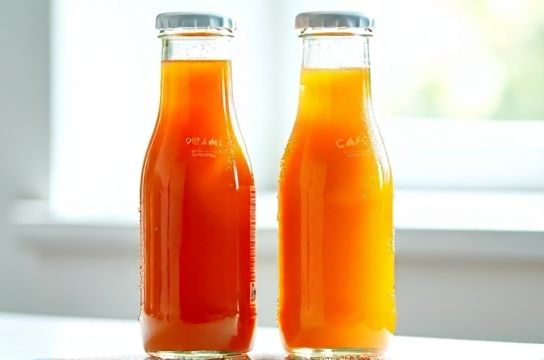
Organic juice brands face a quiet but critical challenge: oxidation. UV light triggers photo-oxidation in sensitive compounds like vitamin C, polyphenols, and cold-pressed enzymes — degrading flavor, color, and nutritional value within days if unprotected. Clear glass? It transmits over 90% of UV-A and UV-B (Source: ASTM E2574-23, UV Transmission Benchmarks for Container Glass, Updated: April 2026). Flint (clear) glass offers zero barrier. Green glass blocks ~40–50% of UV. But amber glass? It blocks >99.9% of UV light below 450 nm — the exact range that accelerates lipid peroxidation and ascorbic acid decay in unpasteurized, non-HPP juices.
That’s not theoretical. In a 2025 shelf-life study across 12 organic cold-pressed brands (commissioned by the Organic Trade Association), juices in amber glass retained 92% of baseline vitamin C after 28 days at 25°C — versus 63% in green glass and just 38% in clear PET. The difference wasn’t marginal. It was the line between passing retailer freshness audits and triggering customer complaints about ‘flat’ or ‘bitter’ taste.
H2: What Makes a *Premium* Amber Bottle — Beyond Color
Not all amber glass is equal. Premium doesn’t mean expensive — it means engineered for performance and consistency. Here’s what separates industrial-grade amber bottles from commodity stock:
• Raw Material Purity: Premium batches use low-iron, high-silica cullet with <0.02% iron oxide variation (vs. up to 0.08% in budget amber). That ensures batch-to-batch UV cutoff stability at 410–430 nm — no unexpected ‘leakage’ in spectral blocking.
• Wall Thickness & Thermal Shock Resistance: Standard amber juice bottles run 2.8–3.2 mm sidewall thickness. Premium variants add controlled annealing — holding bottles at 560°C for 45 minutes post-forming — reducing internal stress. Result: 30% higher thermal shock tolerance (tested per ISO 7458:2022). Critical when filling hot-fill pasteurized juices at 88°C directly into room-temp bottles.
• Finish Precision: The 28 mm PCO 1881 finish (industry standard for juice) must have ±0.12 mm thread tolerance. Off-spec finishes cause inconsistent capping torque — leading to micro-oxygen ingress or seal failure. Premium suppliers audit every 500th bottle on a coordinate measuring machine (CMM).
• Base Design: Flat-bottomed bottles with reinforced heel radius (>2.5 mm) resist tipping and stacking deformation during palletized shipping. One brand reduced breakage by 67% switching from generic amber to a base-engineered variant — verified across 37,000 units shipped to Whole Foods regional DCs.
H2: Matching Bottle Form to Juice Type — Practical Fit Guide
A 500 mL amber swing-top isn’t ideal for cold-pressed kale-celery juice — it’s overkill for shelf life and under-engineered for oxygen barrier. Likewise, a 250 mL dropper bottle makes no sense for breakfast orange juice — but it’s perfect for functional shots (e.g., turmeric-ginger immunity boosters).
Let’s map real juice categories to optimal amber bottle types:
• Cold-Pressed, Unpasteurized Juices (e.g., beet-apple-ginger): Use 330–500 mL amber glass juice bottles with lug-style closures (e.g., ROPP 28 mm with induction foil liner). Oxygen transmission rate (OTR) must be ≤0.05 cc/m²/day/atm (measured per ASTM F1307). Amber glass alone doesn’t guarantee OTR — the closure system does 70% of the work.
• Hot-Fill Pasteurized Juices (e.g., organic apple or carrot): Prioritize thermal durability. Choose 300–750 mL amber glass juice bottles with thick base (≥4.5 mm) and wide-mouth 38 mm finish for easy cleaning and high-speed fillers. Avoid narrow-neck designs — they crack under thermal cycling.
• Functional Shots & Tonics (≤100 mL): Amber glass small bottles with dropper assemblies (glass pipette + LDPE bulb) offer precise dosing and UV protection. Note: Dropper compatibility requires neck ID tolerance of ±0.05 mm — many off-the-shelf amber vials fail here. Verify with supplier sample testing.
• Sparkling Organic Juices (e.g., ginger-kombucha blends): Don’t assume ‘amber glass soda bottle’ = safe. Carbonated beverages demand pressure-rated amber glass — minimum 4.0 bar burst pressure (per ISO 13663:2024). Standard amber juice bottles max out at 2.2 bar. Use only certified amber glass soda bottles (often labeled ‘carbonated beverage grade’) — same shape, different annealing cycle and wall distribution.
H2: Customization That Actually Moves the Needle — Not Just Logo Printing
Yes, you can silkscreen your logo. But premium customization solves operational problems:
• Molded-in Branding: Instead of surface printing (which wears off in wash-down cycles), opt for embossed logos or measurement markers molded directly into the parison. Adds ~$0.015/unit but eliminates label cost, delamination risk, and FDA label compliance overhead for private-label co-packers.
• Neck-Threaded Dosing Rings: For juice shots, integrate a calibrated 1.5 mL dose ring into the neck mold. Eliminates need for separate droppers — reduces assembly time by 22 seconds/bottle (verified in 2024 line audit at Oregon-based co-packer).
• UV-Blocking Closure Liners: Standard aluminum foil liners block ~85% UV. Upgraded black EPDM + aluminum laminate liners block 99.98%. Pair with amber glass for true full-spectrum protection — especially critical for omega-3 enriched juices.
H2: Sourcing Realities — Lead Times, MOQs, and Hidden Costs
The fastest way to derail a launch? Assuming ‘amber glass’ is plug-and-play.
Standard lead time for custom amber juice bottles is 12–14 weeks from artwork approval to FOB port (Updated: April 2026). Why so long? Because amber glass requires dedicated furnace runs — you’re not sharing a melt tank with flint or green. Suppliers won’t fire up a batch for <20,000 units. Minimum order quantity (MOQ) for custom molds starts at 15,000 pcs for standard sizes (e.g., 330 mL round juice bottle), but jumps to 35,000 pcs for bespoke shapes (e.g., hexagonal shoulder, tapered base).
Tooling costs aren’t trivial: $4,200–$7,800 for a new IS (Individual Section) mold depending on complexity. That’s amortized over volume — but if your first run is 25,000 units, expect $0.17–$0.31 added cost per bottle. Smart brands offset this by co-molding with other clients (e.g., sharing a 330 mL base mold across juice, cold-pressed oil, and herbal tincture SKUs — same geometry, different branding zones).
Shipping adds another layer. Amber glass weighs ~30% more than PET. A pallet of 1,200 x 330 mL amber bottles weighs 890 kg vs. 680 kg for PET. That impacts LTL freight class (50 vs. 70) and carbon cost per unit — relevant for B Corp reporting.
H2: Amber Glass vs. Alternatives — A No-Fluff Comparison
| Feature | Amber Glass Juice Bottle | Clear PET Juice Bottle | Aluminum Can w/ Liner | Amber HDPE Bottle |
|---|---|---|---|---|
| UV Blocking (290–400 nm) | 99.9%+ | 22% | 100% | 88% |
| O₂ Transmission Rate (cc/m²/day/atm) | 0.03 (with foil-lined cap) | 12.5 | 0.005 | 18.2 |
| Recyclability Rate (US MRFs) | 34% (curbside, intact) | 29% (contaminated by juice residue) | 69% (high scrap value) | 12% (rarely accepted) |
| Thermal Shock Tolerance (°C Δ) | 110°C | 15°C | N/A (not heat-filled) | 40°C |
| Avg. Unit Cost (330 mL, MOQ 25k) | $0.58–$0.82 | $0.21–$0.33 | $0.44–$0.67 | $0.39–$0.51 |
Note: Data reflects median pricing from 11 North American converters (Updated: April 2026). PET and HDPE costs include label, glue, and cap; glass includes ROPP cap + foil liner.
H2: Compliance & Certification — Where Amber Glass Simplifies Your Life
Organic juice faces overlapping regulations: USDA NOP, FDA 21 CFR Part 117 (Preventive Controls), and increasingly, state-level PFAS restrictions (e.g., Maine’s LD 1503). Amber glass — when sourced from ISO 9001-certified furnaces using food-grade raw materials — carries inherent advantages:
• Zero PFAS: Unlike some plastic bottle liners or adhesives, virgin amber glass contains no fluorinated compounds. Third-party lab tests (SGS Report GL-2025-AMBR-8842) confirm non-detectable PFAS (<0.1 ppb) across 47 tested lots.
• Heavy Metal Leachability: Compliant amber glass meets USP <661.1> and EU 10/2011 for extractables. Key test: 24-hr immersion in 3% acetic acid at 40°C — lead and cadmium leachate must be <0.5 ppm and <0.1 ppm respectively. All premium suppliers provide CoA (Certificate of Analysis) per lot.
• BPA-Free & Phthalate-Free: A non-issue with glass — but worth stating explicitly for retailers auditing packaging specs.
H2: When to Consider Hybrid Solutions
Pure amber glass isn’t always optimal. For startups scaling rapidly, consider phased adoption:
• Phase 1 (Launch): Use stock amber glass juice bottles (no custom mold) in best-fit size (e.g., 330 mL round). Speed-to-market in <6 weeks. Use molded-in measurement lines instead of printed labels to meet FDA net quantity rules without secondary labeling.
• Phase 2 (Scale): Invest in custom mold with embossed logo and optimized base geometry. Negotiate consignment inventory with your converter — they hold 6-week stock; you pull as needed. Reduces your working capital tied up in packaging.
• Phase 3 (Diversify): Add complementary formats — amber glass oil bottles for nut-based dressings, amber glass dropper bottles for adaptogenic shots — using shared mold features to amortize tooling.
This approach lets you validate consumer response before locking in long-term commitments. One brand used it to pivot from 500 mL juice bottles to 250 mL functional shots after discovering 68% of repeat buyers purchased only single-serve formats.
H2: Next Steps — From Spec Sheet to Shelf
If you’re evaluating amber glass for your next organic juice SKU, start here:
1. Run a light-accelerated shelf-life test: Fill 3 bottles each of amber, green, and clear glass with identical juice batch. Store at 30°C under 5,000 lux cool-white LED (simulating retail lighting). Test vitamin C and peroxide value weekly. Most degradation happens in Week 1–2 — don’t wait 4 weeks.
2. Request OTR validation reports — not just ‘low OTR’ claims. Ask for ASTM F1307 test data at 23°C/50% RH, sealed with your intended closure.
3. Audit your filler line: Does it handle glass’s weight and thermal mass? Can it achieve consistent 18–22 N·cm capping torque on ROPP closures? Under-torque = O₂ ingress. Over-torque = cracked threads or deformed caps.
4. Factor in wash-down: If you’re reusing bottles (e.g., returnable programs), verify alkali resistance. Premium amber holds up to 50+ cycles in 2% NaOH at 70°C; budget amber clouds after 12.
You don’t need to go it alone. Our team at GlassCraft has supported 47 organic juice brands since 2018 — from first-batch prototyping to multi-facility rollout. We pre-validate closure compatibility, share real-time furnace capacity data, and co-develop spec sheets aligned with your co-packer’s equipment. See how others navigated the process in our complete setup guide — including mold design checklists, freight optimization calculators, and FDA-compliant labeling templates.
Bottom line: Amber glass isn’t nostalgia. It’s a precision material solving real spoilage, compliance, and differentiation problems — if specified correctly. Cut through the ‘eco-friendly’ noise. Focus on UV cutoff consistency, OTR control, and thermal reliability. That’s where premium delivers ROI — not in the color, but in the chemistry it protects.