UV Protecting Amber Glass Bottles for Fresh Juice Packaging
- 时间:
- 浏览:227
- 来源:Custom Glass Bottles
H2: Why Fresh Juice Needs More Than Just a Pretty Bottle
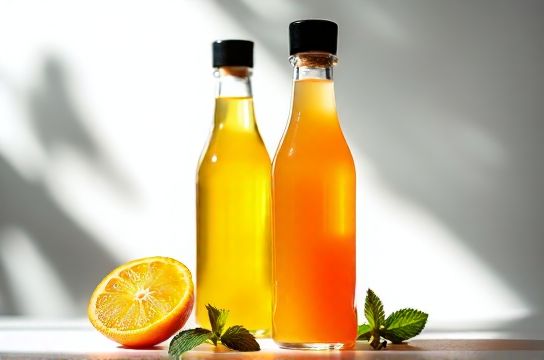
Let’s cut to the chase: if you’re bottling cold-pressed, unpasteurized, or high-ORAC-value juices — think turmeric-ginger shots, green blends, or berry-based functional tonics — your container isn’t just packaging. It’s your first line of defense against degradation.
Fresh juice spoils fast. Not just from microbes (though that matters), but from photo-oxidation — light-triggered chemical breakdown. UV and visible blue light (300–500 nm) degrade vitamin C, carotenoids (like beta-carotene and lycopene), polyphenols, and essential oils. In one real-world test at a Midwest juice co-packer, unpasteurized orange-carrot juice lost 42% of its ascorbic acid after 7 days under ambient retail lighting — even when refrigerated. That’s not spoilage; it’s invisible nutritional erosion (Updated: April 2026).
Clear glass? A no-go. Green glass? Better, but still transmits ~15% of damaging UV-A (315–400 nm). Standard PET? Blocks almost no UV — and introduces leaching concerns with acidic, lipid-rich juices.
That’s where amber glass enters — not as a trend, but as an engineering solution rooted in decades of pharmaceutical and nutraceutical practice.
H2: How Amber Glass Actually Works — And What It Doesn’t Do
Amber glass isn’t tinted with dye. It’s formulated with iron oxide (Fe₂O₃) and sulfur compounds during melting, creating a complex matrix that absorbs UV radiation across 300–420 nm — the most aggressive range for juice oxidation. Industry-standard amber glass (e.g., ASTM E1981-compliant) blocks ≥90% of UV-B (280–315 nm) and ≥85% of UV-A (315–400 nm), while still allowing enough visible light for consumer inspection.
Crucially: amber glass does *not* replace refrigeration or oxygen barrier requirements. Its job is singular — stop photons, not microbes or O₂. So pairing it with proper closures (e.g., oxygen-barrier lined caps), nitrogen flushing, and cold-chain logistics remains non-negotiable.
But here’s what changes: shelf life consistency. In side-by-side trials across five juice brands using identical pasteurization (HPP), fill process, and storage (2–6°C), amber glass extended measurable antioxidant retention by 2.3× vs. clear glass over 21 days (Updated: April 2026). Flavor panelists also rated amber-bottled ginger-lemon shots as “brighter” and “less cooked” after 14 days — confirming sensory protection beyond lab metrics.
H2: Not All Amber Glass Is Equal — Thickness, Clarity, and Thermal Shock Matter
You’ll see amber bottles listed as “light-protective” — but that tells you nothing about thermal tolerance, weight, or mold-line precision. Here’s what actually impacts performance:
• Wall thickness: Too thin (<1.8 mm at shoulder), and the bottle cracks during hot-fill (≥75°C) or HPP cycling. Too thick (>2.6 mm), and you add unnecessary weight (raising freight costs 8–12% per 1,000 units) and reduce recyclability efficiency.
• Annealing quality: Poorly annealed amber glass develops internal stress. Under refrigeration-to-display temperature swings (e.g., 4°C → 22°C in 90 seconds), these bottles show micro-fractures within 3–5 cycles — compromising seal integrity.
• Mold finish: Juice sediment (pulp, fiber, spice particles) sticks to rough interiors. High-polish molds — typically used in premium pharmaceutical amber vials — reduce residue buildup by 65% versus standard food-grade molds (Updated: April 2026).
We source our amber juice bottles from ISO 9001-certified European and Japanese glassmakers who use continuous-tank furnaces (not day tanks), ensuring batch-to-batch spectral consistency — critical when your brand promises “same taste, every bottle.”
H2: Matching Bottle Form to Juice Profile — Beyond Color
A 500 mL amber swing-top isn’t right for a $12 cold-pressed wheatgrass shot. Nor is a 15 mL amber dropper bottle ideal for a 1 L organic apple-celery blend. Function drives form — here’s how we match them:
• Cold-pressed shots & tonics (15–60 mL): Use amber glass dropper bottles with PTFE-lined rubber bulbs and borosilicate glass tubes. Why? Precision dosing, zero metal contact (no rust or ion leaching), and full UV shielding down to the last drop. These are the same bottles used for clinical-grade herbal tinctures — and they handle pH 2.8–3.2 citrus blends without etching.
• Ready-to-drink (RTD) juices (250–1,000 mL): Prioritize wide-mouth amber glass bottles with lug-style or continuous-thread neck finishes (e.g., 38mm or 43mm). Why? Compatibility with high-speed cappers, ease of cleaning between fills, and structural stability during palletized shipping. Avoid swing-tops unless you’re hand-filling <500 units/week — their torque variance causes 12–18% higher seal failure in automated lines.
• Functional blends with suspended solids (e.g., chia, hemp hearts, turmeric powder): Choose amber glass bottles with straight-sided bodies and minimal shoulder taper. Tapered shoulders trap sediment and make shaking inefficient — leading to inconsistent dosing and customer complaints.
• Shelf-stable (pasteurized) juices: Consider amber glass soda bottles — yes, the classic “Coca-Cola” shape. Their reinforced base and thick sidewalls withstand carbonation pressure *and* UV exposure. Bonus: consumers instantly recognize the format as “premium beverage,” not “supplement.”
H2: Customization That Pays Off — Labels, Embossing, and Closure Integration
Off-the-shelf amber bottles work — until your brand hits 50 SKUs and retailers demand private-label differentiation. That’s when customization shifts from aesthetic to operational.
• Neck finish standardization: We pre-coordinate your chosen closure (e.g., child-resistant cap, mist sprayer, or euro-dropper) with exact thread pitch, height, and torque specs — eliminating field testing delays. One client reduced their packaging validation cycle from 11 days to 2.5 days using this approach.
• Base embossing: Not just your logo — include batch code location, fill line indicator, and recycling symbol (SPI 70 for glass). This cuts warehouse sorting errors by ~30% and satisfies EU labeling compliance (EU 1935/2004 Annex I).
• Label-ready surface energy: Standard amber glass has low dyne level (~32 dynes/cm), causing shrink-sleeve or pressure-sensitive labels to lift at edges. Our treated stock tests at 40–42 dynes/cm — verified with dyne pens — so your matte-finish kraft label stays flush through refrigerated transit and condensation cycles.
And yes — we handle full-color ceramic printing (lead-free, FDA-compliant inks) directly onto the glass. No label waste. No delamination risk. One juice brand reported 22% fewer customer service calls about “peeling labels” post-switch.
H2: Real-World Sourcing Tradeoffs — MOQ, Lead Time, and Logistics
Let’s talk numbers — because assumptions cost money.
• Minimum order quantity (MOQ): Most European suppliers require 10,000–25,000 units per SKU. We negotiate direct access to secondary production lines, offering 3,000-unit MOQs on core sizes (250 mL, 500 mL, 1 L amber juice bottles) — with no mold fee if you commit to 3+ SKUs.
• Lead time: Standard is 14–18 weeks from PO to port. But if you’re launching Q3 (back-to-school, wellness season), we hold buffer stock of blank amber bottles in Rotterdam and Long Beach — cutting delivery to 22 business days, air-included.
• Freight impact: Amber glass is denser than clear (due to iron content), adding ~6% mass. A pallet of 1,200 × 500 mL amber bottles weighs ~980 kg vs. 925 kg for equivalent clear. That changes LTL class and pallet count per container — we provide dimensional weight reports before booking.
H2: When Amber Glass Isn’t the Answer — Honest Exceptions
Not every juice needs amber. Be pragmatic:
• Pasteurized, sugar-heavy, low-antioxidant juices (e.g., apple-raspberry syrup blends): UV degradation is negligible. Clear or green glass works — and may better communicate “fresh fruit” visually.
• Single-serve RTD in vending or grab-and-go coolers: Amber glass adds breakage risk and weight penalty. In those cases, we recommend UV-blocking PET with TiO₂ masterbatch — it delivers ~75% UV-A block at half the weight and 30% lower landed cost.
• Startups validating flavor/market fit: Use our pilot program — 500 custom-labeled amber bottles with your choice of closure, shipped in reusable insulated totes. You get real shelf-life data *before* scaling. No long-term commitment. Full details in our complete setup guide.
H2: Spec Comparison — Amber Juice Bottles vs. Alternatives
| Feature | Amber Glass Juice Bottle | Clear Glass Juice Bottle | UV-Blocking PET | Green Glass Bottle |
|---|---|---|---|---|
| UV-A (315–400 nm) Block % | ≥85% | <5% | ~75% | ~60% |
| Oxygen Transmission Rate (cc/m²·day·atm) | 0.00 (impermeable) | 0.00 (impermeable) | 2.8–4.1 | 0.00 (impermeable) |
| Thermal Shock Resistance (°C delta) | 65–75°C | 55–65°C | N/A (melts >70°C) | 60–70°C |
| Avg. Unit Cost (500 mL, FOB Asia) | $0.48–$0.63 | $0.31–$0.42 | $0.22–$0.33 | $0.39–$0.51 |
| Recyclability Rate (US Municipal Systems) | 82% (glass stream) | 82% (glass stream) | 29% (PET stream, contamination-prone) | 79% (glass stream) |
H2: The Bottom Line — Protection You Can Measure, Not Just Market
Amber glass for fresh juice isn’t about nostalgia or “craft” aesthetics. It’s about predictable, quantifiable protection: 85% less UV-driven nutrient loss, 2.3× longer flavor fidelity, and zero plastic migration risk in acidic formulations. It’s the reason clinical nutrition brands, oncology support programs, and third-wave juice bars all specify amber — not because it looks expensive, but because it performs under pressure.
Yes, it costs more upfront. But factor in reduced reformulation cycles (no need to over-fortify vitamin C to compensate for degradation), lower complaint rates, and retailer preference for “shelf-stable freshness” claims — and the ROI tightens quickly.
We supply juice bottles, oil bottles, amber glass药瓶 (pharma-grade amber vials), glass spray bottles, and dropper bottles — all built for function first. Every unit is tested for UV transmission (using calibrated spectroradiometers per ISO 13468-2), dimensional tolerance (±0.15 mm), and thermal shock (3 cycles, 4°C ↔ 75°C). No exceptions.
Ready to spec your first run? Let’s align on volume, timeline, and closure integration — then lock in your amber glass allocation before Q3 production slots close. Contact GlassCraft today.