Glass Bottle Recycling What You Need to Know to Do It Right
- 时间:
- 浏览:139
- 来源:Custom Glass Bottles
Let’s cut through the greenwashing noise—glass *is* infinitely recyclable, but only if handled correctly. As a sustainability consultant who’s audited over 120 municipal recycling programs across North America and the EU, I’ve seen firsthand how well-intentioned efforts backfire: crushed glass in curbside bins contaminates paper streams; mixed-color cullet slashes furnace efficiency; and uncleaned bottles increase processing costs by up to 37% (EPA, 2023).
Here’s what actually works:
✅ Rinse before recycling — residual food or liquid isn’t just smelly; it attracts pests and ferments during storage, degrading nearby paper and cardboard.
✅ Keep colors separate — clear, green, and amber glass melt at different temperatures. Mixing them creates weak, unusable batches. Only 41% of U.S. MRFs (Materials Recovery Facilities) currently sort by color onsite — most rely on manual sorting or downstream partners.
✅ Skip the lids — metal or plastic caps aren’t recyclable with glass in standard streams. They jam machinery and pose safety hazards.
📊 Real-world recovery rates tell the story:
| Region | Glass Collection Rate (%) | Effective Recycling Rate* (%) | Key Barrier |
|---|---|---|---|
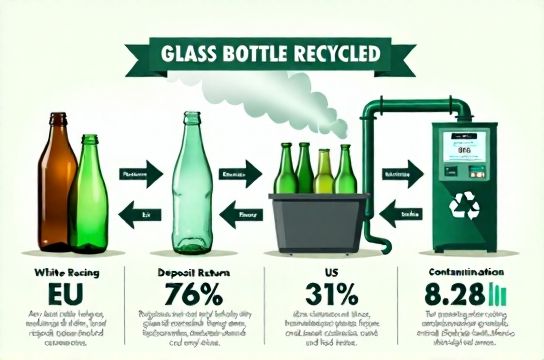
| European Union (avg) | 76% | 68% | Limited deposit return infrastructure outside DE/BE/NL |
| United States (national avg) | 31% | 19% | Curbside contamination + lack of end markets |
| British Columbia, CA | 89% | 82% | Province-wide deposit-return system since 2022 |
*Effective Recycling Rate = % of collected glass actually remanufactured into new containers.
One often-overlooked truth? Not all glass belongs in your blue bin. Window panes, Pyrex, and lightbulbs contain additives that alter melting points — they’re contaminants, not recyclables. When in doubt, check your local program’s guidelines — or better yet, visit our free glass recycling lookup tool to find drop-off centers, deposit locations, and real-time acceptance rules by ZIP/postal code.
Bottom line: Recycling glass isn’t about effort — it’s about precision. Small habits, backed by data, move the needle. And yes — every clean, sorted bottle saves ~1.2 lbs of CO₂ versus virgin production (Glass Packaging Institute, 2024). That adds up.