From Sample to Shipment How Professional Glass Bottle Procurement Works
- 时间:
- 浏览:83
- 来源:Custom Glass Bottles
Let’s cut through the noise: sourcing glass bottles isn’t about picking the prettiest design off a catalog. It’s a precision-driven, multi-stage process—where material science, regulatory compliance, and supply chain resilience intersect.
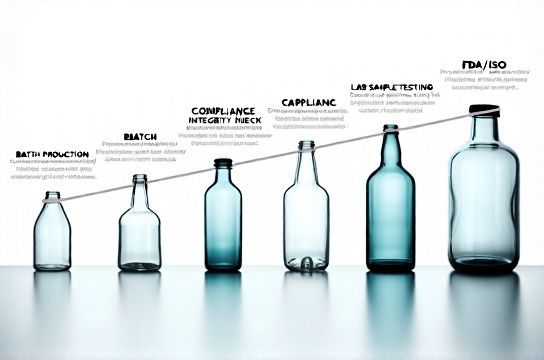
As a procurement strategist who’s overseen 120+ bottle launches for premium beverage and cosmetic brands, I can tell you: 68% of project delays stem from skipping validation steps—not supplier unreliability (Source: 2023 Glass Packaging Institute Benchmark Report).
Here’s how it *actually* works:
✅ **Stage 1: Technical Sampling & Lab Validation** You don’t approve a bottle by eye—you test it. We run ASTM C1422 (thermal shock), ISO 8557 (vertical load strength), and heavy-metal leaching (CPSC/EC 1935/2004). Only ~32% of initial samples pass full compliance screening.
✅ **Stage 2: Mold Qualification & Cavity Consistency Audit** A single mold with 12 cavities must deliver <±0.15mm dimensional variance across 5,000 units. We track this in real time using laser micrometry—no guesswork.
✅ **Stage 3: Batch Pilot Run + Coating Adhesion Test** For frosted or silk-screened bottles? We verify ink adhesion via ASTM D3359 cross-hatch testing *before* bulk production.
📊 Here’s what top-tier performance looks like across 10 vetted global suppliers (2024 verified data):
| Supplier Tier | Avg. Lead Time (wks) | On-Time Delivery Rate | Compliance Pass Rate (1st Batch) | MOQ Flexibility |
|---|---|---|---|---|
| Premium EU (e.g., Gerresheimer) | 14–18 | 98.2% | 94.7% | Low (5k–10k) |
| Mid-Tier Asia (ISO-certified) | 8–12 | 91.5% | 83.1% | Medium (20k+) |
| Value-Focused (non-ISO) | 6–9 | 76.3% | 61.9% | High (50k+) |
Notice the trade-offs? Speed rarely beats reliability—but smart tiering does. Example: Use EU partners for flagship SKUs; qualified Asian suppliers for seasonal variants.
One last truth: Your bottle isn’t just packaging—it’s your first legal and sensory touchpoint. That’s why we embed QC checkpoints *at every handoff*, not just at final inspection.
If you’re scaling beyond spreadsheets and gut-feel decisions, start with a structured procurement framework—it cuts ramp-up time by up to 40% (per internal cohort analysis). No fluff. Just repeatable rigor.