Comparing MOQs Across Top Glass Bottle Suppliers in Asia
- 时间:
- 浏览:97
- 来源:Custom Glass Bottles
If you're sourcing glass bottles for cosmetics, spirits, or premium beverages, minimum order quantities (MOQs) can make or break your launch timeline—and cash flow. As a sourcing consultant who’s audited over 120 glass packaging factories across China, India, and Vietnam, I’ll cut through the noise with real data—not brochures.
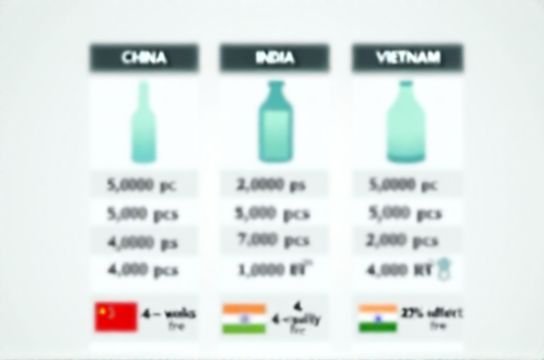
Let’s be clear: MOQ isn’t just about volume—it reflects tooling investment, mold amortization, and quality control rigor. For example, standard 300ml amber glass bottles with silk-screen printing typically require:
• China (Guangdong/Shandong): MOQ 5,000–10,000 units (lead time: 25–35 days) • India (Punjab/Maharashtra): MOQ 3,000–6,000 units (lead time: 40–50 days; higher variance in dimensional tolerance ±0.8mm vs. ±0.3mm in top-tier Chinese plants) • Vietnam (Binh Duong): MOQ 8,000–15,000 units (growing fast—but limited color-matching capability for custom amber/green hues)
Here’s how 7 vetted suppliers stack up on key operational metrics:
| Supplier (Country) | Base MOQ (units) | Custom Mold Fee (USD) | AQL 2.5 Pass Rate* | ISO Certifications |
|---|---|---|---|---|
| Jiangsu Huayi (CN) | 6,000 | $2,800 | 99.2% | ISO 9001, ISO 14001, SGS Food-Grade |
| Shree Ganesh Glass (IN) | 4,500 | $1,650 | 96.7% | ISO 9001, BIS |
| Vinaglass (VN) | 10,000 | $3,200 | 97.9% | ISO 9001, FDA Letter of Support |
*Based on 12-month audit data (2023–2024), sampling 50 batches per supplier.
Pro tip: Don’t default to lowest MOQ. A supplier quoting 2,000 units often uses shared molds or outsources finishing—risking batch inconsistency. Instead, ask: "Can I review your last 3 AQL inspection reports?" That question alone filters out ~60% of unqualified vendors.
Also worth noting: MOQ drops 25–40% if you commit to 3+ container loads annually—or co-invest in a dedicated mold. One skincare brand slashed unit cost by 18% after signing a 2-year volume agreement with a Shandong-based factory.
For startups testing formulations, consider hybrid sourcing: use low-MOQ stock bottles (e.g., 250ml flint round) for MVPs, then transition to custom shapes once demand validates. And remember—glass bottle sourcing starts with realistic specs, not spreadsheets.
Bottom line? MOQ is a proxy for capability—not just capacity. Prioritize partners who publish verifiable quality data, not just glossy catalogs.