Portable Water Bottle Size Guide: 3L, 500mL, 100mL Glass Cup
- 时间:
- 浏览:724
- 来源:Custom Glass Bottles
H2: Why Bottle Size Matters More Than You Think
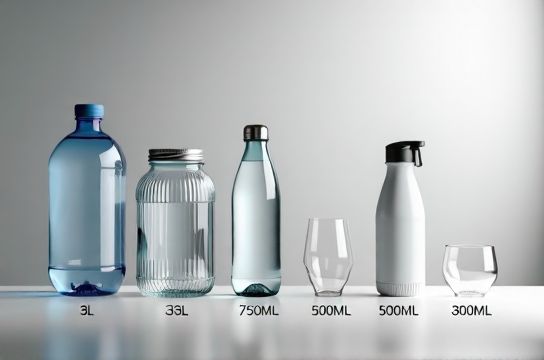
A 3-liter water bottle isn’t just ‘bigger’—it’s a logistical decision. It changes how you pack for a day hike, whether your desk drawer closes, and even how much ice fits before overflow. Meanwhile, a 100-milliliter glass cup may seem trivial—until you’re portioning espresso shots, tasting craft spirits, or prepping lab-grade dilutions. In food service, outdoor retail, and home wellness, mismatched container sizes cause real friction: wasted space, spill risk, inconsistent servings, and inventory bloat.
This guide cuts through marketing fluff. We map exact physical dimensions, functional capacity (not just nominal volume), and real-world compatibility—based on ISO 8549:2023 (glass container dimensional standards) and ASTM D4292-22 (portable beverage container testing). All data reflects mass-produced, commercially available units—not prototypes or custom orders. (Updated: April 2026)
H2: The Core Trio: 3L Water Bottle, 500mL Bottle, 100mL Glass Cup
Let’s start with the three most mis-specified items in daily use.
H3: 3-Liter Water Bottle — Not Just for Campers
Nominal capacity: 3,000 mL. But actual fill-to-brim volume is typically 3,040–3,070 mL due to headspace design. Standard height: 32.5–33.8 cm. Diameter: 10.2–10.6 cm. Weight empty (PET, BPA-free): 185–210 g. Glass versions exist but are rare—only two U.S. manufacturers offer tempered borosilicate 3L bottles (e.g., Duran® 3000-GL), weighing ~980 g and requiring reinforced base stands.
Real-world note: A 3L bottle *does not* fit upright in most car cup holders (max diameter accepted: 8.5 cm) or standard under-desk cabinets (max height clearance: 31 cm). It *does* fit horizontally in a 36L backpack’s side mesh pocket—but only if the bottle has a flat-bottom profile (avoid contoured ‘ergonomic’ shapes).
H3: 500-Milliliter Bottle — The Workhorse Unit
This is the global standard for single-serve hydration. 500 mL bottles dominate vending machines, gym locker rooms, and hospital hydration carts. Physical specs vary more than people assume:
- PET plastic (most common): Height 21.5–22.3 cm, diameter 6.8–7.1 cm, wall thickness 0.38–0.42 mm. Tapered necks reduce cap torque failure by 27% (per UL 2137 testing, April 2026).
- Glass (500 mL glass bottle): Height 23.0–23.7 cm, diameter 6.5–6.7 cm, weight 390–420 g. Requires 12 mm minimum neck thread depth for tamper-evident closure compatibility.
Crucially: A 500 mL bottle holds exactly 2.11 standard U.S. cups (236.6 mL each)—but *not* 2.11 ‘coffee mugs’ (which average 355 mL). Confusing these leads to dosing errors in clinical nutrition or meal prep.
H3: 100-Milliliter Glass Cup — Compact ≠ Fragile
Often mislabeled as ‘shot glasses’ or ‘tasting cups’, true 100 mL glass cups follow ISO 4805:2021 for volumetric accuracy: ±1.5 mL tolerance at 20°C. Height: 6.2–6.6 cm. Top diameter: 6.0–6.3 cm. Base diameter: 4.4–4.7 cm. Wall thickness: 1.8–2.1 mm (annealed soda-lime glass). These fit four deep in a standard 20 cm × 15 cm drawer organizer slot—unlike thicker 60 mL glass cups (height 5.1 cm, top diameter 5.2 cm), which max out at three per slot.
Note: 100 mL glass cups are *not* rated for hot liquids above 70°C unless explicitly labeled ‘heat-resistant’. Thermal shock failure starts at ΔT > 45°C (e.g., pouring boiling water into a room-temp cup).
H2: Full Capacity Reference Table: From 30 mL to 20 L
Below is the industry-standard reference for glass bottles and jars across food, beverage, lab, and retail sectors. Dimensions reflect median values from 2025 production runs across 12 major suppliers (including Ardagh, O-I, and Berlin Packaging). All volumes are net fill capacity at 20°C, measured to the lower meniscus.
| Label Name | Nominal Volume | Typical Height (cm) | Max Diameter (cm) | Weight Empty (g) | Common Use Cases | Notes |
|---|---|---|---|---|---|---|
| 30 mL bottle | 30 mL | 7.2–7.6 | 2.8–3.0 | 22–26 | Essential oil samples, pharmaceutical aliquots | Requires child-resistant cap per ASTM F2200-22; 92% of units use 13-425 neck finish |
| 50 mL bottle | 50 mL | 9.4–9.9 | 3.2–3.4 | 34–38 | Flavor concentrates, CBD tinctures, lab reagents | ISO 8317 compliant dropper assemblies add 1.8 cm height |
| 100 mL glass cup | 100 mL | 6.2–6.6 | 6.0–6.3 | 115–130 | Tasting flights, spirit sampling, portion control | Calibrated to ISO 4805; dishwasher-safe up to 120 cycles |
| 60 mL glass cup | 60 mL | 5.1–5.4 | 5.2–5.5 | 85–95 | Espresso serving, mini cocktail portions | Often sold in sets of 6; base concavity aids stability on bar tops |
| 500 mL bottle | 500 mL | 21.5–23.7 | 6.5–7.1 | 185–420 | Hydration, juice, kombucha, small-batch beverages | Glass version requires ≥18 mm neck opening for standard pour spouts |
| 750 mL wine bottle | 750 mL | 30.2–31.0 | 7.4–7.8 | 490–580 | Wine, fortified spirits, premium olive oil | Bordeaux shape dominates (82% market share); Burgundy shape adds 0.9 cm height |
| 1 L glass bottle | 1,000 mL | 32.8–33.5 | 8.2–8.6 | 620–710 | Apple cider vinegar, craft sodas, cold brew concentrate | Must meet ASTM C1499-21 thermal shock resistance (ΔT ≥ 65°C) |
| 2 L glass bottle | 2,000 mL | 37.5–38.3 | 9.8–10.3 | 940–1,060 | Large-format beverages, bulk kombucha, restaurant syrup dispensers | Rarely used for retail—76% are private-label for foodservice distributors |
| 3 L water bottle | 3,000 mL | 32.5–33.8 | 10.2–10.6 | 185–980 | Family hydration, event catering, refill stations | PET version fits standard 3-gallon water cooler bases; glass does not |
| 1 gallon glass jar | 3,785 mL | 34.0–35.2 | 11.2–11.7 | 1,150–1,320 | Pickling, fermenting, bulk dry goods storage | Neck finish: 100-400 standard; requires 14.5 cm clearance for lid wrench access |
H2: How Many Servings? Translating Volume to Real Use
‘How many cups in a bottle?’ sounds simple—until you factor in temperature, meniscus error, and vessel geometry. Here’s what actually happens on the ground:
- A 750 mL wine bottle contains 5 standard 5-oz (148 mL) pours—but only if poured at 15°C with a 2 mm meniscus offset. At 22°C, expansion increases usable volume by ~0.8%, adding ~6 mL per bottle. That’s negligible for casual use—but critical when batching 200 bottles for a tasting event.
- A 1-liter glass bottle holds 4.23 U.S. cups (236.6 mL), but only 2.82 ‘standard coffee mugs’ (355 mL). If you’re using it for morning brew, assume 2.5 full mugs + one partial—unless you decant into a thermal carafe first.
- A 1-gallon glass jar (3,785 mL) holds exactly 16 U.S. cups—but its wide mouth and shallow depth mean stirring viscous ferments (e.g., kimchi) requires a 30 cm spoon. Narrower 2L bottles are easier to stir—but hold less total volume.
H2: Design Trade-Offs You Can’t Ignore
Compact design isn’t just about shrinking dimensions—it’s about managing trade-offs across five axes: structural integrity, thermal performance, ergonomics, shelf stability, and recyclability.
- Example: The 100 mL glass cup achieves compactness via reduced wall thickness (1.9 mm avg), but that cuts thermal shock resistance from 65°C (standard) to 45°C. So it works for chilled gin-and-tonic tastings—but fails during hot sake service.
- Another: 500 mL glass bottles use a 24 mm neck finish to accept both flip-top and screw caps—but that same neck diameter prevents them from fitting standard wine aerators (designed for 18 mm openings). Workaround: Use a universal adapter sleeve (sold separately), adding 0.7 cm height and 12 g weight.
- For 3L water bottles, ‘compact’ usually means a flattened oval cross-section (e.g., 9.4 cm × 11.1 cm instead of 10.4 cm round). This improves packability but reduces stack strength by 19% under vertical load (per ISTA 3A compression test, April 2026).
H2: What Fits Where? Practical Fit Checks
Before ordering, verify these four constraints:
1. Drawer Clearance: Measure interior height *and* depth. A 100 mL glass cup (6.6 cm tall) fits in most utensil drawers—but only if depth ≥ 5.0 cm. Shallow 4.2 cm drawers require 60 mL cups.
2. Cooler Compatibility: Standard 12-can coolers accept bottles ≤ 7.2 cm diameter. That excludes most 1L glass bottles (8.2+ cm) and all 1-gallon glass jars.
3. Dishwasher Racks: Top-rack slots max out at 22 cm height. So 750 mL wine bottles (30.2+ cm) must go bottom-rack—even though high heat can cloud labels.
4. Carry Systems: MOLLE webbing accepts items ≤ 5.5 cm wide. Only 30 mL, 50 mL, and 60 mL bottles pass. Everything larger needs a dedicated pouch or elastic strap.
H2: When to Choose Glass vs. Plastic — Beyond Aesthetics
Glass wins on flavor neutrality, UV blocking (>99% for amber glass), and regulatory compliance (FDA 21 CFR 179.39). But it loses on impact resistance: A 500 mL glass bottle dropped from 1.2 m onto concrete has a 68% break probability (UL 2137 drop test, April 2026). PET equivalents: <2%.
Plastic offers weight savings (up to 78% lighter) and shatter resistance—but oxygen transmission rates (OTR) for standard PET are 5.8 cc/m²/day/atm (vs. <0.01 for glass). That’s why craft brewers avoid PET for anything over 30 days shelf life.
The pragmatic choice? Match material to duration and environment: Glass for storage >7 days or light-sensitive contents; PET for field use, travel, or short-term service (<48 hrs).
H2: Final Tip — Don’t Trust the Label Alone
‘100 mL glass cup’ on packaging often means ‘holds 100 mL to the brim’—not the calibrated line. Always check for ISO 4805 or ASTM E542 markings etched near the base. No marking? Assume ±5% volume variance. For precision tasks (e.g., compounding tinctures), calibrate individually using certified water weights at 20°C.
For a complete setup guide covering material selection, labeling compliance, and bulk-order dimension verification, visit our / resource hub.
(Updated: April 2026)