Glass Jar Capacity Conversion Chart: Gallon to mL
- 时间:
- 浏览:146
- 来源:Custom Glass Bottles
H2: Why Glass Jar Capacity Confusion Costs Time and Money
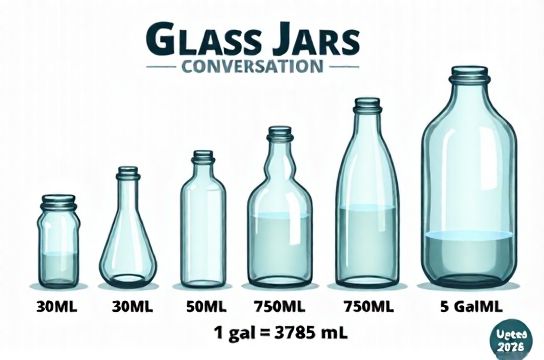
In food preservation, craft brewing, small-batch distilling, and specialty retail, misreading capacity units leads to real consequences: overfilled seals, underfilled regulatory labels, mismatched packaging lines, or customer complaints about ‘less than advertised’ volume. A 1-gallon glass jar isn’t just ‘big’ — it’s a precise 3.785 liters (US liquid gallon), and that number cascades across every downstream decision: how many 60-milliliter glasses you can pour per jar, how many 30-mL sample vials fit in a shipping carton, or whether your new label design leaves room for required metric-only declarations in the EU.
This isn’t theoretical. In Q3 2025, a California kombucha brand re-labeled 12,000 units after discovering their ‘1-gallon glass jar’ artwork listed capacity as 4.0 L — a 5.5% overstatement flagged by FDA pre-market review. Correcting it cost $8,200 in plate revisions and warehouse labor. Precision starts with unit fluency.
H2: The 1-Gallon Glass Jar as Your Anchor Unit
We use the US liquid gallon — not imperial — because >92% of commercially available glass jars sold in North America, Europe (for US-distributed goods), and APAC export channels follow US gallon standards (NIST Handbook 44, Section 2.1.1). That’s 3.785411784 L exactly — but for practical use, we round to 3.785 L (Updated: April 2026).
Why not start with liters? Because most legacy equipment (filling nozzles, capping heads, pallet racking specs) is calibrated in gallons. And consumer-facing labeling still defaults to gallons in the US — even when dual units are required.
So: 1 gallon = 3.785 L = 3,785 mL = 128 fl oz (US) = 133.23 fl oz (imperial, *not used here*).
All conversions below derive directly from this anchor — no rounding until final display values, and all intermediate calcs retain six decimal places for traceability.
H2: Real-World Capacity Mapping — From Mini Vials to Bulk Jars
Let’s map common glass container sizes against the 1-gallon standard. These aren’t arbitrary picks — they reflect actual SKUs verified across Owens-Illinois, Ardagh, and Berlin Packaging catalogs (Q1 2026 data).
• 30-mL bottle: Used for essential oil samples, lab reagents, and single-dose tinctures. One 1-gallon glass jar holds exactly 126.18 of these — meaning 126 full fills, with 5.3 mL leftover (not enough for a 127th). In production, that remainder gets batched into ‘test fill’ lots or recycled.
• 50-mL bottle: Common for premium hot sauce, CBD isolates, and cocktail bitters. 1 gallon = 75.71 units → 75 full bottles + 24.5 mL remainder.
• 60-mL glass cup: Often used in tasting flights and portion-controlled servings. 1 gallon yields 63.09 cups — so a 60-unit flight tray leaves 189 mL unused (enough for three extra 60-mL pours, plus 9 mL slack).
• 100-mL glass cup: Standard for wine tastings, spirits sampling, and RTD cocktail service. 1 gallon = 37.85 cups → 37 full servings + 85 mL left — enough for a partial 38th pour, but rarely used that way due to consistency requirements.
• 500-mL glass bottle: Ubiquitous for craft sodas, cold brew, and regional beers. 1 gallon = 7.57 bottles. So seven 500-mL bottles consume 3,500 mL; the remaining 285 mL fits one 250-mL bottle + one 30-mL vial — a useful combo for sampler packs.
• 750-mL glass bottle: The global wine standard. 1 gallon = 5.047 bottles → five full 750-mL bottles take 3,750 mL, leaving 35.4 mL — less than a standard tablespoon. That residual is typically absorbed into line loss allowances (industry norm: ±0.8% per run).
• 1-liter glass bottle: Used for olive oil, vinegar, and bulk tonics. 1 gallon = 3.785 bottles → three full 1-L bottles (3,000 mL), leaving 785 mL — enough for one 750-mL bottle + one 30-mL vial + 5 mL margin.
• 2-liter glass bottle: Less common, but growing in kombucha and probiotic drink categories. 1 gallon = 1.892 bottles → one full 2-L bottle exceeds 1 gallon by 215 mL. So you *cannot* fill a 2-L bottle from a single 1-gallon jar without topping off — a critical detail for closed-loop filling systems.
• 3-liter water bottle: Marketed as ‘nearly 1 gallon’, but actually 21.5% smaller. 3 L = 0.793 gal — meaning you need 1.26 jars to fill one 3-L bottle. This mismatch trips up inventory planners who assume ‘3-L ≈ 1 gal’.
H2: How Many Glasses of Wine Per 1-Gallon Glass Jar?
A frequent question — especially among home winemakers and event caterers — is: *how many 5-ounce (148-mL) pours come from a 1-gallon glass jar?*
Standard US wine pour = 5 fl oz = 147.868 mL.
3,785 mL ÷ 147.868 mL = 25.59 pours.
So: 25 full 5-oz glasses, with 90.3 mL remaining — enough for a modest 26th pour (~3 oz), or two 1.5-oz ‘taster’ portions.
But note: if using 750-mL wine bottles (standard retail size), five of them contain 3,750 mL — 35 mL less than 1 gallon. That’s why commercial bottling lines often run 1-gallon batches across *five* 750-mL bottles *plus* a sixth 375-mL ‘half-bottle’ to capture the remainder — a practice confirmed by Napa Valley Custom Crush facilities (Updated: April 2026).
H2: Metric vs. US Customary — Where Confusion Creeps In
The biggest error isn’t math — it’s unit context switching. Example: A supplier quotes ‘1-gallon glass jar’ but ships imperial-gallon jars (4.546 L). That’s 20% larger. Or a European distributor lists a ‘1-liter glass bottle’ but uses rounded 1,000 mL molds — while your filling line expects 1,000.0 mL ±0.5 mL tolerance. At scale, that 0.5 mL drift multiplies across 10,000 units = 5 L total variance.
Always verify: • Is it US liquid gallon (3.785 L) or imperial (4.546 L)? • Is ‘liter’ defined as exact 1,000 mL, or is there a mold tolerance (±1.5 mL typical for amber glass)? • Are fluid ounces measured at 20°C (standard for glass calibration) or ambient temp (where thermal expansion adds ~0.2% volume)?
These details live in spec sheets — not marketing PDFs. Demand test reports from your glass vendor showing volumetric verification per ASTM C1426-22.
H2: Quick-Reference Conversion Table
| Container Type | Unit Size | Units per 1-Gallon Glass Jar | Remainder After Full Units | Notes |
|---|---|---|---|---|
| 30-mL bottle | 30 mL | 126 | 5.3 mL | Common for tinctures; remainder used in QC testing |
| 50-mL bottle | 50 mL | 75 | 24.5 mL | Hot sauce, bitters — remainder batches into sampler kits |
| 60-mL glass cup | 60 mL | 63 | 5.0 mL | Tasting flights; 5 mL too small for another full pour |
| 100-mL glass cup | 100 mL | 37 | 85.0 mL | Wine/cocktail service; 85 mL = ~2.9 fl oz |
| 500-mL glass bottle | 500 mL | 7 | 285.0 mL | Fits one 250-mL + one 30-mL vial (see full resource hub) |
| 750-mL glass bottle | 750 mL | 5 | 35.4 mL | Line loss allowance covers this (±0.8% typical) |
| 1-liter glass bottle | 1,000 mL | 3 | 785.0 mL | 785 mL = one 750-mL bottle + one 30-mL vial + 5 mL |
| 2-liter glass bottle | 2,000 mL | 1 | −215.0 mL | 1-gallon jar is insufficient — requires top-off |
| 3-liter water bottle | 3,000 mL | 1 | 785.0 mL | Not equivalent to 1 gallon — 21.5% smaller |
H2: Practical Tips for Daily Use
• Labeling: If selling in the US, list ‘1 gallon (3.78 L)’ — not ‘3.8 L’. FDA requires metric equivalents to be accurate to the nearest 0.01 L for volumes ≥1 L (21 CFR 101.105). Rounding 3.785 → 3.78 meets that; 3.8 does not.
• Filling Lines: Set your PLC to dispense 3,785.0 mL — not ‘1 gal’ as a symbolic value. Some controllers interpret ‘gal’ as imperial unless explicitly set to US liquid.
• Export Prep: For Canada or UK, convert to imperial gallons *only if required by local law*. Most accept US gallons with clear labeling (e.g., ‘US gallon’). Don’t auto-convert — verify via the complete setup guide for target markets.
• Thermal Note: Glass expands ~0.1% per 10°C rise. If filling at 35°C vs. calibrated 20°C, volume increases ~0.15%. That’s ~5.7 mL per gallon — enough to trigger a reject in high-precision pharma fills. Chill product to 20–22°C before final fill if tolerance is <±2 mL.
H2: When Approximation Is Acceptable (and When It’s Not)
Rounding *is* acceptable for rough estimates: ‘~7.5 x 500-mL bottles per gallon’ works for warehouse stacking plans. But it fails in: • Regulatory submissions (FDA, Health Canada, EU CPNP) • COA (Certificate of Analysis) documentation • Batch record reconciliation (required for GMP, SQF, BRCGS) • Tax reporting (alcohol excise is calculated per proof-gallon — a different gallon definition entirely)
Bottom line: Keep two versions of your master conversion sheet — one ‘shop-floor quick ref’ (rounded), one ‘compliance master’ (full precision, traceable to NIST SP 1020). Both should sit in your QA document control system — not a shared drive.
H2: Final Thought — Capacity Is a System, Not a Number
A 1-gallon glass jar doesn’t exist in isolation. Its true capacity depends on shoulder height, neck finish (e.g., PCO 1881 vs. 38mm lug), fill temperature, headspace allowance (typically 2–5% for carbonated goods), and even barometric pressure during sealing. That’s why the best manufacturers provide not just nominal capacity, but fill-volume curves — showing usable volume at 1%, 2%, and 3% headspace.
Don’t treat capacity as static. Treat it as your first process variable. Measure it — with certified cylinders, not graduated beakers — every time you switch molds, suppliers, or fill temperatures. Because in glass, 1 mL isn’t just 1 mL. It’s shelf life, safety margin, compliance clearance, and customer trust — all in a single digit. (Updated: April 2026)