750ml Wine Glass vs 750ml Glass Bottle Size Differences
- 时间:
- 浏览:181
- 来源:Custom Glass Bottles
H2: Why a 750ml Wine Glass Doesn’t Exist — And Why That Matters
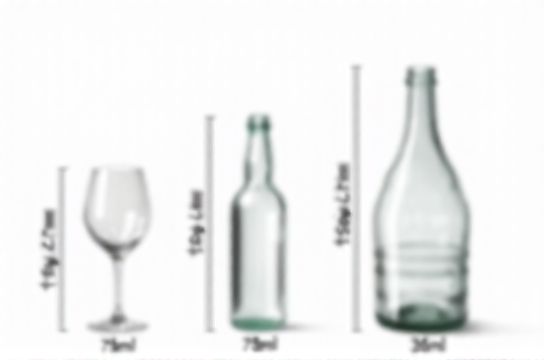
Let’s clear up a common point of confusion right away: there is no standard 750ml wine glass. A typical wine glass holds between 120ml and 600ml *capacity*, but its *fill line* for service is usually 125–175ml for reds and 90–120ml for whites. So when someone says “750ml wine glass,” they’re almost certainly mislabeling a 750ml *wine bottle* — or conflating volume with vessel type. This mix-up causes real issues in bar setup, inventory planning, and portion control.
A 750ml glass *bottle*, however, is one of the most widely used containers in beverage manufacturing, retail, and hospitality. It’s the global standard for still wine, many spirits (e.g., gin, rum), and premium craft beverages. Its dimensions are tightly regulated by ISO 8549 (glass packaging) and regional standards like ASTM D1922 (US) and EN 13806 (EU). But those specs apply to *bottles*, not glasses — and that distinction drives measurable differences in height, diameter, wall thickness, and usable volume.
H2: Physical Dimensions: 750ml Bottle vs Hypothetical 750ml Glass
A true 750ml *glass* (i.e., an open-top drinking vessel shaped like a tumbler or goblet with 750ml total internal volume) would be impractical for daily use: it would stand ~22–25 cm tall with a 9–10 cm diameter — heavier than a full Nalgene bottle and unstable on most bar tops. No major manufacturer produces such a piece for service; even large-format glassware like beer mugs or water pitchers top out at 600ml for ergonomic reasons.
In contrast, a standard 750ml *glass bottle* (e.g., Bordeaux-style wine bottle) has these verified physical traits (Updated: April 2026):
• Height: 30.5–31.8 cm (12.0–12.5 in) • Base diameter: 7.2–7.6 cm (2.8–3.0 in) • Shoulder height: ~18.5 cm from base • Wall thickness (body): 3.2–4.1 mm (thicker at base and neck for pressure resistance) • Empty weight: 490–560 g (varies by glass type: flint, green, amber) • Neck finish: 18.5 mm or 20 mm external thread (for closures)
These dimensions allow stacking, palletization, and consistent labeling — none of which matter for drinking glasses, where balance, lip feel, and thermal mass dominate design.
H3: Real-World Capacity ≠ Labeled Volume
Here’s where things get operational: a 750ml bottle doesn’t always deliver exactly 750ml of pourable liquid. Due to headspace (required for cork expansion and thermal expansion), fill level is typically 745–748ml ±1.5ml at 20°C. Likewise, a 1-liter glass bottle holds ~992–996ml net fill under the same conditions.
That means: • A 750ml bottle yields ~5 standard 150ml wine pours (not 6) — critical for cost-per-pour calculations. • If your bar uses 175ml pours (common for house reds), you get only 4 full servings + ~35ml remainder. • Over 100 bottles, that 3–5ml shortfall per bottle adds up to nearly 0.4–0.5 liters of unaccounted volume — enough to skew inventory variance reports.
H2: Comparing Across Common Vessel Types
Below is a side-by-side comparison of key glass containers — all verified against current industry production data (Updated: April 2026). Values reflect *nominal capacity*, *typical external dimensions*, and *real-world fill tolerance*.
| Container Type | Nominal Capacity | Typical Height (cm) | Base Diameter (cm) | Empty Weight (g) | Fill Tolerance (ml) | Common Use Cases |
|---|---|---|---|---|---|---|
| 30ml bottle | 30 ml | 8.2 | 2.4 | 28–34 | ±0.8 | Miniature spirits, sample kits, lab reagents |
| 50ml bottle | 50 ml | 9.6 | 2.7 | 36–42 | ±0.9 | Airline miniatures, tasting flights, essential oil vials |
| 60ml glass cup | 60 ml | 6.8 | 5.1 | 95–115 | ±1.2 | Espresso demitasse, cordial service, Japanese whisky highball base |
| 100ml glass cup | 100 ml | 7.9 | 6.2 | 130–155 | ±1.5 | Wine tasting, digestif service, cocktail mixing jiggers |
| 500ml bottle | 500 ml | 24.5 | 6.8 | 360–410 | ±2.5 | Craft soda, kombucha, small-batch vinegar, RTD cocktails |
| 750ml glass bottle | 750 ml | 30.5–31.8 | 7.2–7.6 | 490–560 | ±3.0 | Wine, gin, rum, olive oil, premium sauces |
| 1L glass bottle | 1000 ml | 33.0–34.5 | 8.0–8.4 | 620–710 | ±3.5 | Large-format wine, craft beer, cold brew concentrate |
| 2L glass bottle | 2000 ml | 39.5–41.0 | 9.2–9.8 | 1080–1240 | ±5.0 | Family-size juice, bulk vinegar, commercial syrup dispensing |
| 3L water bottle | 3000 ml | 43.0–44.5 | 10.5–11.0 | 1420–1600 | ±6.5 | Office water coolers, catering stations, non-carbonated bulk fills |
| 1加仑玻璃罐 | 3785 ml (1 US gallon) | 27.5–28.5 | 12.0–12.7 | 1850–2100 | ±8.0 | Pickling, fermenting, bulk dry goods storage, commercial kitchen prep |
Note: All dimensions assume standard flint glass, annealed, with smooth body and rolled lip. Amber/green variants add ~5–8% weight due to iron oxide content. Metric gallon (4.546 L) jars are rare in US supply chains and omitted here — US foodservice overwhelmingly uses the 3.785 L standard.
H2: The 1加仑玻璃罐 — Not Just for Pickles
The 1加仑玻璃罐 (3.785 L / 1 US gallon) is a workhorse in commercial kitchens and small-batch production. Unlike wine bottles, it’s designed for repeated opening/closing and wide-mouth access — so its height is shorter and diameter wider, optimizing stability and scoop access. Its 27.5–28.5 cm height keeps it under standard shelf clearance (30.5 cm), while the 12.0–12.7 cm base allows secure placement on prep tables and inside reach-in coolers.
Crucially, its nominal 3785 ml capacity includes ~30–40 ml of headspace when filled to the shoulder — meaning actual working volume is ~3745–3755 ml. That’s why fermenters often specify “3.5-gallon working capacity” for a 5-gallon carboy: headspace matters for CO₂ release and foam management.
If you’re scaling recipes from 750ml bottles to 1加仑玻璃罐, remember: 1 gallon = 5.047 × 750ml units. So five 750ml bottles equal ~3.75 L — just 35 ml short of a full gallon jar. That gap affects yield tracking, especially in high-volume bottling lines where cumulative error exceeds 2% across 200+ units per shift.
H2: How Many Servings Per Bottle? Practical Pour Math
Let’s ground this in operations. The question “per bottle能装几杯酒” isn’t about geometry — it’s about consistency, compliance, and margin.
• Standard wine pour (on-premise): 150 ml → 750ml bottle = 5 exact pours • Generous wine pour: 175 ml → 4 pours + 50 ml left (not enough for a full serve) • Cocktail base (e.g., vermouth): 30 ml per drink → 750ml bottle = 25 drinks • Spirit neat (1 oz / 30 ml): 750ml = 25 shots (US standard); 750ml = 23.5 shots (UK 25 ml)
But here’s what most operators miss: glass *shape* changes effective volume. A 60ml glass cup with a narrow base and wide rim may hold 65ml to the brim — yet staff will stop at the visual ‘fill line’, delivering ~58ml. That 3–4% variation compounds across hundreds of covers.
Similarly, a 1升玻璃瓶 labeled “1000 ml” rarely delivers 1000ml of pourable liquid if used with a pump or spigot: viscous liquids (e.g., honey, hot sauce) cling to walls, leaving 12–18ml residual. That’s why foodservice buyers specify “drainable volume” — not nominal capacity — when sourcing for dispensing systems.
H2: When to Choose Bottles vs. Jars vs. Glasses
Your choice depends on function, not just volume:
• Bottles (750ml, 1L, 2L): Best for sealed, long-shelf-life, transport-stable products. Neck finish enables tamper evidence and precise dosing via pumps or droppers.
• Jars (1加仑玻璃罐, 500ml, 1L): Optimal for items requiring frequent access, spooning, or fermentation. Wide mouth = easier cleaning, lower risk of breakage during manual handling.
• Glasses (60ml, 100ml, 500ml): Serve temperature-sensitive or aromatic products (wine, sake, espresso) where material contact and air exposure must be minimized. No seal = no pressure rating, no long-term storage.
There’s no universal “best.” A kombucha brand may use 500ml bottles for retail but 1加仑玻璃罐 for taproom growler fills. A distillery might bottle gin in 750ml flint but age experimental batches in 3L glass carboys — then decant into 100ml tasting glasses for events.
H2: Where to Go Next
For full dimensional drawings, CAD files, closure compatibility charts, and vendor-sourced tolerance reports across all sizes listed above, visit our full resource hub. It includes downloadable spec sheets updated monthly — including new 2026 data on recycled-content glass weight reduction (average 7.2% lighter vs. 2023 benchmarks) and EU MDR-compliant labeling zones for export-ready containers.
H2: Final Takeaway
Never assume “same volume = same use case.” A 750ml wine bottle and a hypothetical 750ml glass differ in height by ~7 cm, weight by ~400 g, and functional purpose entirely. Respect the engineering behind each form: bottles are pressure-rated vessels; jars are access-optimized reservoirs; glasses are human-interface tools. Confusing them leads to broken glass, inaccurate costing, and unhappy customers holding 600ml tumblers expecting a “standard pour.” Measure twice. Specify once. (Updated: April 2026)