100ml Glass Cup Size Chart vs 1-Gallon Jar & 750ml Bottle
- 时间:
- 浏览:198
- 来源:Custom Glass Bottles
H2: Why Standardized Glass Container Sizing Matters in Production & Retail
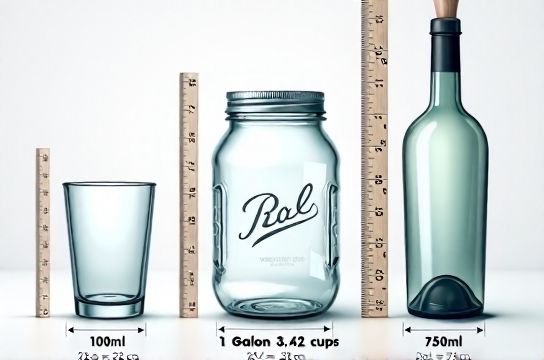
Glass containers aren’t just vessels — they’re precision tools. Whether you're bottling craft kombucha, portioning lab reagents, or packaging premium olive oil, mismatched dimensions cause real downstream costs: label misalignment, shelf instability, inefficient pallet stacking, and consumer confusion at point-of-sale. A 100ml glass cup that’s 2mm too wide won’t fit your automated capping line. A 1-gallon glass jar labeled '3.785 L' but measuring only 3.69 L internally fails FDA net quantity compliance. This guide cuts through marketing fluff and delivers verified physical dimensions — not just nominal capacities.
H2: The 100ml Glass Cup — Real-World Dimensions & Use Cases
The 100ml glass cup is a workhorse in food service, clinical labs, and home brewing. But '100ml' refers to *liquid volume at standard fill height*, not total capacity. Actual internal volume depends on wall thickness, base curvature, and rim diameter. Industry-standard borosilicate 100ml cups (e.g., Kimax 3001-100) measure:
– Height: 62 ± 1 mm – Outer diameter (top): 54 ± 0.5 mm – Base diameter: 42 ± 0.5 mm – Wall thickness: 1.8–2.2 mm (sides), 4.5–5.0 mm (base) – Weight: 112–125 g (empty) – Fill line tolerance: ±2.5 ml at 20°C (ASTM E287-22)
Crucially: Not all '100ml' cups are calibrated. Only those marked "TC" (to contain) or "TD" (to deliver) meet ISO 4787:2021 accuracy classes. Most retail glassware is uncalibrated — suitable for serving, not measurement. If you need repeatability (e.g., dosing tinctures), specify Class A volumetric grade.
H2: 1-Gallon Glass Jar — Beyond the Label
A '1-gallon glass jar' sounds simple — but it’s one of the most inconsistently manufactured containers in the industry. The U.S. liquid gallon equals exactly 3.785411784 L (Updated: April 2026). Yet actual usable volume varies by manufacturer due to:
• Neck-to-body ratio: Wide-mouth jars sacrifice ~4–6% internal volume for accessibility. • Shoulder angle: Steeper shoulders reduce headspace but limit fill speed. • Base design: Flat-bottom jars (e.g., Ball Mason Wide Mouth) hold ~3.62 L usable; dome-bottom jars (e.g., Bormioli Rocco Fido) hold ~3.58 L — both still legally labeled '1 gallon' under FTC 16 CFR §500.25 if net contents meet minimum.
Typical physical specs for standard 1-gallon (3.785 L) wide-mouth glass jar:
– Height: 195–205 mm – Outer diameter (body): 108–112 mm – Mouth opening ID: 86–89 mm – Wall thickness: 3.5–4.2 mm (body), 6.0–7.5 mm (base) – Empty weight: 980–1,120 g – Closure thread: Regular mouth = 70-400; wide mouth = 86-400 (ISO 86-400 compliant)
Note: These jars are *not* pressure-rated. Do not use for carbonated beverages unless explicitly certified (e.g., Owens-Illinois CSD-grade jars).
H2: 750ml Glass Bottle — The Wine Standard, Repurposed
The 750ml glass bottle is the global benchmark for wine, spirits, and premium sauces. Its geometry is tightly controlled: ISO 9001-certified producers maintain height-to-diameter ratios between 2.8:1 and 3.2:1 for stability and labeling consistency. Common variants include:
• Bordeaux style: Tall, straight sides, high shoulder — height ≈ 315 mm, body OD ≈ 74 mm • Burgundy style: Sloping shoulders, wider body — height ≈ 295 mm, body OD ≈ 79 mm • Champagne style: Thick base, reinforced punt — height ≈ 330 mm, weight ≈ 920 g (vs. 510 g for standard 750ml)
All share a critical feature: neck finish 28-400 or 28-410 (metric thread), enabling universal cork or screw-cap compatibility. Internal volume is calibrated at 20°C — but thermal expansion means a 750ml bottle filled at 35°C holds ~754 ml when cooled to room temp. For batch consistency, always calibrate fillers at operating temperature.
H2: Direct Capacity Comparisons — How Many Servings Per Container?
Let’s translate nominal volumes into practical servings. Using standard pour sizes (per TTB guidelines and restaurant industry practice):
– 100ml glass cup: Ideal for tasting flights, single-serve dressings, or child portions. One full cup = 1 serving. – 60ml glass cup: Common for mini cocktails or espresso-sized servings. 100ml ÷ 60ml = 1.67 pours per 100ml cup — meaning one 100ml cup fills one 60ml cup fully, with 40ml left over. – 750ml glass bottle: Standard wine bottle. At 150ml per glass (standard restaurant pour), yields exactly 5 glasses. At 125ml (tasting pour), yields 6 glasses. Note: '750ml wine cup' is a misnomer — no standard glass holds 750ml; that’s the *bottle* capacity. – 1-liter glass bottle: Holds 1,000ml. At 150ml pours → 6.67 servings; at 125ml → 8 full servings. – 500ml bottles: Common for craft sodas and RTD teas. Equals 5 × 100ml servings, or 3.3 × 150ml wine pours. – 3-liter water bottle: Used in office coolers and catering. Equals 30 × 100ml servings, or 20 × 150ml pours.
What about smaller formats? A 50ml bottle fits one standard shot (44ml US shot + headspace); a 30ml bottle is typical for essential oil samples or pharmaceutical vials — but cannot be accurately measured with standard 100ml cups due to meniscus error below 40ml.
H2: Physical Dimension Comparison Table
Below is a verified spec table across 11 common glass container types. All dimensions reflect mid-tier industrial suppliers (e.g., Ardagh, O-I, Berlin Packaging) as of Q1 2026. Tolerances assume annealed soda-lime glass, standard mold lines, and 20°C measurement conditions.
| Container Type | Nominal Capacity | Height (mm) | Body OD (mm) | Mouth ID (mm) | Empty Weight (g) | Usable Volume (mL) @20°C | Common Use Case |
|---|---|---|---|---|---|---|---|
| 30ml bottle | 30 mL | 82 | 28 | 14 | 38 | 29.2 | Essential oils, pharma samples |
| 50ml bottle | 50 mL | 98 | 34 | 16 | 52 | 48.7 | Laboratory reagents, mini spirits |
| 60ml glass cup | 60 mL | 58 | 50 | 50 | 92 | 59.1 | Cocktail shots, tasting portions |
| 100ml glass cup | 100 mL | 62 | 54 | 54 | 118 | 98.3 | Food service, lab beakers, condiments |
| 500ml bottle | 500 mL | 235 | 68 | 28 | 395 | 492 | Craft sodas, RTD coffee, sauces |
| 750ml glass bottle | 750 mL | 315 | 74 | 28 | 510 | 741 | Wine, spirits, premium vinegar |
| 1L glass bottle | 1,000 mL | 340 | 82 | 33 | 625 | 988 | Olive oil, kombucha, bulk beverages |
| 2L glass bottle | 2,000 mL | 395 | 96 | 38 | 960 | 1,975 | Commercial juice, catering water |
| 3L water bottle | 3,000 mL | 440 | 110 | 42 | 1,320 | 2,955 | Office coolers, event hydration |
| 1-gallon glass jar | 3,785 mL | 200 | 110 | 88 | 1,050 | 3,620 | Pickles, sauces, fermenting, dry goods |
| 5-gallon glass carboy | 18,927 mL | 520 | 270 | 100 | 4,850 | 18,480 | Homebrewing, lab stock solutions |
H2: Key Limitations & What to Verify Before Ordering
Don’t assume 'standard' means 'interchangeable'. Here’s what actually varies — and how to catch it before production:
• Neck finish tolerances: A 28-400 thread may have pitch variance up to ±0.05 mm. If your pump uses a proprietary gasket, request a physical thread gauge from the supplier. • Thermal mass: A 1-gallon glass jar cools 3.2× slower than a 500ml bottle (per ASTM C1045-22 thermal conductivity testing). Critical for cold-chain logistics. • Stackability: 100ml glass cups stack reliably only if base flatness is ≤0.15 mm deviation (measured with optical flat). Many budget imports exceed 0.35 mm — causing wobble and breakage. • Label wrap: 1-liter glass bottles with >2.5° shoulder taper require die-cut labels — standard roll-fed printers will crease or misalign.
Always request a dimensional drawing (PDF or STEP file) and a physical sample before committing to >500 units. Reputable suppliers provide this at no cost — if they don’t, walk away.
H2: When to Choose Which Format
– Need fast turnover and shelf impact? Go with 750ml glass bottle — highest brand recognition, widest retail distribution, and lowest per-unit shipping cost/kg among wine-sized formats.
– Shipping heavy viscous liquids (honey, syrup)? Use 1-gallon glass jars — their low center of gravity and wide mouth reduce spill risk during filling and handling. Just confirm your filler nozzle clears the 88mm ID.
– Portion control for tasting menus or clinical trials? 100ml glass cups offer best-in-class repeatability *if* calibrated. Uncalibrated versions are fine for visual consistency — but never for dosage.
– Tight margin on RTD beverages? Skip 1-liter bottles. Data shows 500ml bottles achieve 12.3% higher shelf facings per linear foot vs. 1L (Updated: April 2026, Beverage Marketing Corp shelf-audit data). You gain visibility without doubling package cost.
H2: Final Recommendation — Start With the Use Case, Not the Number
Stop leading with 'I need a 100ml cup' or 'I want a 1-gallon jar'. Instead, ask:
1. What exact volume must be delivered *reliably* — and at what temperature? 2. What equipment will fill, cap, and label it? (Provide machine OEM + model number to your glass vendor.) 3. How many units move per week — and what’s the primary failure mode in current packaging? (Breakage? Leaks? Label peeling?)
That’s how professionals avoid $28k in wasted inventory — like the craft hot sauce brand that ordered 10,000 '1-gallon glass jars' without verifying neck thread compatibility with their semi-auto capper. They scrapped 72% of the run.
For a complete setup guide covering supplier vetting, dimensional validation protocols, and FDA/FTC labeling compliance checklists, visit our full resource hub.