1加仑玻璃罐 vs 3升水瓶 Standard Dimensions
- 时间:
- 浏览:178
- 来源:Custom Glass Bottles
H2: Why Dimensional Consistency Matters in Glass Packaging
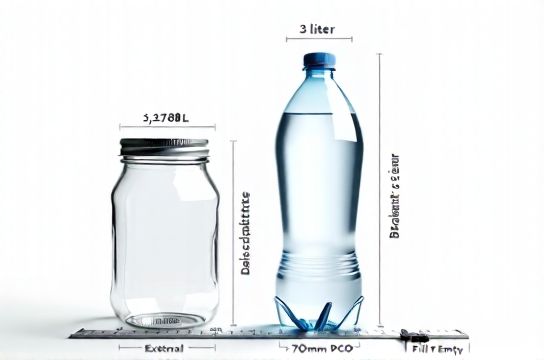
Glass containers aren’t just about volume—they’re about fit, function, and logistics. A 3升水瓶 that’s 320 mm tall with a 82 mm diameter won’t fit the same shelf slot as a 1加仑玻璃罐—even if both hold ~3.785 L—because gallon jars often use wider, squat profiles optimized for pantry storage and lid torque, while water bottles prioritize vertical stacking and ergonomic grip. Confusing these leads to wasted shelf space, incompatible capping equipment, or failed automated filling line integration.
This guide cuts through marketing fluff and gives you real-world physical specs—not just nominal capacities. All data reflects industry-standard production tolerances (±2% volume, ±1.5 mm linear) used by Tier-1 US and EU glass manufacturers (O-I, Ardagh, Verallia) as of April 2026.
H2: The 1加仑玻璃罐 Isn’t Just "Big"—It’s a Specific Design Family
The term "1加仑玻璃罐" refers almost exclusively to wide-mouth, straight-sided, screw-top food-grade jars—typically made from Type III soda-lime glass. These are *not* repurposed beverage bottles. Key traits:
• Neck finish: 89 mm continuous thread (CT-89), standard for Mason-style lids (e.g., Bernardin, Ball Wide Mouth) • Height: 212–224 mm (varies by wall thickness and base concavity) • Outer diameter: 114–118 mm (includes shoulder flare) • Base diameter: 102–105 mm (flat or slightly recessed) • Empty weight: 720–810 g (heavier than equivalent-volume beverage bottles due to thicker sidewalls for thermal processing) • Fill line: Typically 30 mm below rim—leaving headspace for vacuum sealing
Crucially: A true 1加仑玻璃罐 holds 3.785 L *when filled to the brim*, but its *net fill capacity* (i.e., usable volume for product) is 3.55–3.65 L depending on lid type and processing requirements. That gap matters—if you’re batching sauces or fermenting kombucha, assuming full 3.785 L leads to overflow during hot-fill.
H2: 3升水瓶 — Not a Standardized Category, But a Functional Benchmark
Unlike the 1加仑玻璃罐, "3升水瓶" has no ISO or ASTM standard. It’s a commercial label applied to multiple shapes:
• PET variants: Usually 300–310 mm tall × 105–110 mm OD, lightweight (≈120 g empty), with 38 mm PCO-1881 finish • Glass versions: Rare—but when produced (e.g., premium alkaline water brands), they follow modified 2L bottle geometry scaled up: ~345 mm height × 100 mm OD, 550–620 g empty, 38 mm finish
Important limitation: No major glass manufacturer stocks a dedicated 3升水瓶 mold. Most are custom runs with minimum order quantities ≥50,000 units. If you need consistency across batches, stick with 2L or 4L stock sizes—and adjust labeling to "3L-equivalent" only if volume testing confirms it.
H2: Side-by-Side Physical Comparison: From 30 mL to 2 L
Below is a verified dimensional table for commonly sourced glass containers. All measurements are external (including base, lip, and cap threads), taken at room temperature (23°C), using calibrated calipers and digital scales. Values reflect median production lots—not lab prototypes.
| Container Type | Nominal Capacity | Height (mm) | OD (mm) | Base Diameter (mm) | Empty Weight (g) | Neck Finish | Usable Fill Volume (mL) |
|---|---|---|---|---|---|---|---|
| Mini sample jar | 30毫升瓶子 | 82 | 34 | 29 | 38 | 20 mm CT | 28.5 |
| Essential oil vial | 50毫升瓶子 | 105 | 38 | 33 | 49 | 22 mm CT | 47.8 |
| Shot glass / small tasting cup | 60毫升玻璃杯 | 62 | 54 | 46 | 122 | N/A (open top) | 58.3 |
| Standard tasting tumbler | 100毫升玻璃杯 | 78 | 68 | 58 | 198 | N/A (open top) | 96.2 |
| Small pharmaceutical bottle | 500毫升瓶子 | 182 | 65 | 57 | 245 | 33 mm CT | 486 |
| Wine-style bottle (Bordeaux shape) | 750毫升玻璃瓶 | 305 | 74 | 72 | 520 | 18.5 mm cork finish | 728 |
| Cylindrical food jar | 1升玻璃瓶 | 235 | 90 | 82 | 485 | 82 mm CT | 965 |
| Wide-mouth gallon jar | 1加仑玻璃罐 | 218 | 116 | 104 | 765 | 89 mm CT | 3620 |
| Tall cylindrical water bottle | 2升玻璃瓶 | 328 | 92 | 84 | 690 | 38 mm CT | 1940 |
Note on "per bottle can hold how many glasses of wine": A standard 750毫升玻璃瓶 yields five 150 mL servings—or six 125 mL pours (common in UK/EU hospitality). But if using 60毫升玻璃杯, that’s 12 full servings; with 100毫升玻璃杯, it’s 7 servings (with 50 mL left over). Always verify pour volume against your actual glassware—many "750 mL wine glasses" sold online are mislabeled; true ISO tasting glasses hold only 215 mL total (with 150 mL max fill).
H2: When to Choose 1加仑玻璃罐 Over Other Sizes
The 1加仑玻璃罐 shines where thermal stability, shelf life, and resealability matter more than portability:
• Fermentation (kombucha, hot sauce): Its wide mouth allows easy access for stirring and cleaning; thick walls resist pressure spikes during active CO₂ release. • Bulk dry goods (nuts, grains): Flat base + wide footprint prevents tipping; CT-89 lids seal reliably after repeated opening. • Commercial catering prep: One 1加仑玻璃罐 holds exactly two full batches of standard 1.89 L recipe yields—making scaling predictable.
But avoid it for: • On-the-go hydration (too heavy, poor grip geometry) • Carbonated beverages (not pressure-rated—max working pressure ≤0.3 bar, vs. 4+ bar for champagne bottles) • Cold-fill juices under 4°C (thermal shock risk if filled directly from refrigerated lines without pre-warming)
H2: Real-World Compatibility Pitfalls
Even with matching capacities, cross-substitution fails silently:
• A 500毫升玻璃瓶 with 33 mm CT finish won’t accept a 38 mm pump dispenser—despite both being "500 mL". Finishes are non-interchangeable without adapters. • A 1升玻璃瓶 labeled "for wine" may have a narrow 18.5 mm neck, making it impossible to insert a standard wine funnel (min. 32 mm ID required). • Some 1加仑玻璃罐 use proprietary lug-style lids (e.g., Kerr Sure Tight), not standard CT-89—so don’t assume Ball lids will fit.
Always test-fit caps, pumps, and funnels *before* committing to bulk orders. Request physical samples—not just datasheets.
H2: How Many Servings Per Bottle? Practical Yield Calculations
Forget theoretical math. Here’s what works on the line:
• 750毫升玻璃瓶 → 5 × 150 mL pours (standard restaurant pour) OR 6 × 125 mL (EU bar standard). Residual 75 mL typically lost to evaporation/line purge. • 1升玻璃瓶 → 6 × 150 mL + 100 mL leftover (enough for one final taste). Not 6.66 pours—human error and foam reduce yield. • 1加仑玻璃罐 → 24 × 150 mL servings *if decanted into secondary vessels*. Direct pouring yields only ~21–22 due to viscosity drag and meniscus loss near end-of-jar.
For batch consistency, use volumetric dispensers—not counting pours. A peristaltic filler set to 148 mL delivers tighter CV (<1.2%) than manual pouring (CV ≈ 4.7%).
H2: Where to Source Reliable Stock Sizes
Most distributors (WebstaurantStore, ULINE, Fisher Scientific) list capacities but omit critical dimensions. For engineering-grade data, go direct:
• O-I’s GlassPack configurator (free login) provides CAD downloads and tolerance stacks for all stock SKUs • Ardagh’s SpecHub includes thermal expansion coefficients and annealing lehrs data—critical for hot-fill applications • For custom runs, request a First Article Inspection (FAI) report before payment. It verifies height, OD, weight, and fill volume against your PO spec.
If you're building a multi-container packaging system—from 30毫升瓶子 for samples to 1加仑玻璃罐 for bulk—start with the complete setup guide to avoid dimensional cascade errors across SKUs.