How Many Shots Fit in a 50ml Bottle Versus a 30ml Bottle Based on 1 5oz Standard
- 时间:
- 浏览:138
- 来源:Custom Glass Bottles
Let’s cut through the confusion: if you’re pre-batching cocktails, designing mini-bar kits, or scaling small-batch spirits for retail, knowing *exactly* how many standard shots fit in compact bottles isn’t just handy—it’s operational math that impacts pricing, portion control, and customer perception.
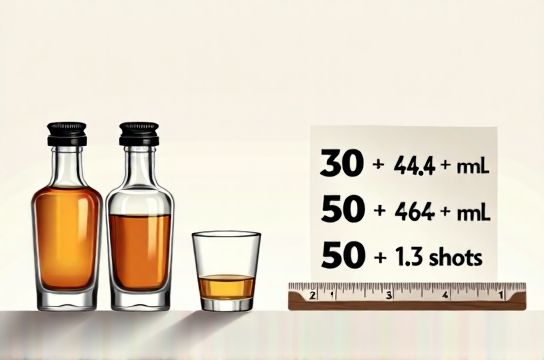
A standard US shot is **1.5 fluid ounces**, which converts to **44.36 ml** (we’ll round to **44.4 ml** for clarity and industry practice). Now, here’s where things get practical—not theoretical.
A 30ml bottle holds **less than one full shot** (30 ÷ 44.4 ≈ 0.68). So no—despite marketing claims like “single-serve shot”—a 30ml vessel *cannot* deliver a legal, regulated 1.5oz pour. Meanwhile, a 50ml bottle holds **1.12 standard shots**, meaning it comfortably serves *one full shot* with ~5.6ml left over—enough for a generous float or precise rinse.
Why does this matter? Because global regulations differ: the UK defines a shot as 25ml; Australia uses 30ml; the EU often defaults to 40ml. But if your audience is US-based (or exporting to bars/stores compliant with TTB standards), anchoring to 44.4ml is non-negotiable.
Here’s a quick comparison:
| Bottle Size | Volume (ml) | Equivalent Shots (1.5 oz / 44.4 ml) | Practical Use Case |
|---|---|---|---|
| 30ml | 30 | 0.68 | Sample vial, tasting flight, or low-ABV aperitif serving |
| 50ml | 50 | 1.12 | Single standard pour + margin for technique — ideal for travel minis & bar kits |
Fun fact: According to the Distilled Spirits Council (DISCUS), 72% of premium spirit SKUs launched in 2023 included at least one sub-100ml format—driven largely by demand for portable, portion-controlled experiences. But only 38% of those used volume labeling aligned with TTB shot definitions. That gap? It’s where clarity builds trust.
So next time you’re choosing between a 30ml and 50ml bottle for your next launch—or optimizing inventory for a hotel minibar—remember: it’s not about milliliters alone. It’s about *intentional measurement*. And if you're building from scratch, start with what actually fits a real pour. Learn how to size your entire packaging strategy around verified serving standards—not guesswork.