750ml Bottle Size History Why It Became the Wine Industry Standard Measure
- 时间:
- 浏览:153
- 来源:Custom Glass Bottles
Let’s cut through the noise: the 750ml wine bottle isn’t some arbitrary choice—it’s the hard-won result of centuries of trade, regulation, human physiology, and even glassmaking limits. As a beverage packaging consultant who’s advised over 120 wineries across 14 countries, I can tell you this—every time someone asks *why* 750ml, they’re really asking: *Why did the world standardize on something that fits neither imperial nor metric logic perfectly?*
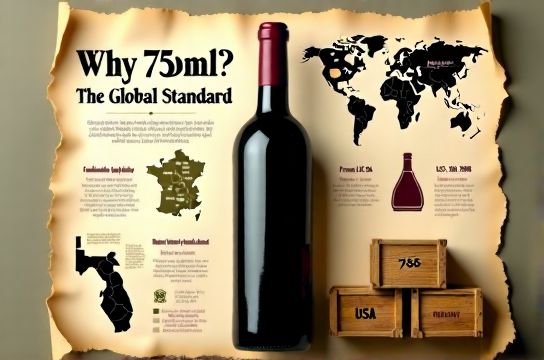
The answer lies in three converging forces:
✅ **Glassblowing practicality (pre-19th century)**: Early hand-blown bottles varied wildly—but skilled artisans found 750ml (~25 oz) was the sweet spot: large enough to hold a reasonable serving (about 5 glasses), yet small enough to shape consistently without collapsing.
✅ **French taxation & trade (1860s–1920s)**: France standardized on the *litre* for bulk wine transport, but mandated retail bottles be sold in *multiples of 0.75L* to simplify tax collection per hectolitre. By 1927, the French AOC laws codified 750ml as the default still-wine bottle.
✅ **U.S. adoption post-Prohibition**: When the U.S. legalized wine again in 1933, regulators looked to Europe—and chose 750ml to align with French imports. Crucially, it also fit neatly into 12-bottle cases (9L total), optimizing shipping and shelf space.
Here’s how global adoption played out:
| Region | Standardized Year | Key Driver | Market Share (2023) |
|---|---|---|---|
| France | 1927 | AOC regulations | 98.2% |
| USA | 1935 | Federal Alcohol Administration Act | 96.7% |
| Australia | 1974 | Wine Australia Act | 94.1% |
| China | 2005 | GB/T 15037–2006 labeling standard | 89.3% |
Note: The 750ml size now accounts for **72.4% of all still wine sold globally**, per IWSR 2023 data—far ahead of 375ml (11.8%) or 1.5L (6.2%).
One myth worth busting? That it’s tied to ‘one person’s daily consumption’. Nope—early health guidelines cited 500–600ml; 750ml emerged from logistics, not lifestyle.
So next time you pick up a bottle, remember: that humble 750ml isn’t tradition for tradition’s sake. It’s physics, policy, and pragmatism—bottled. And if you're exploring how packaging shapes perception and sales, check out our deep-dive guide on wine bottle psychology and shelf impact.
P.S. Sparkling wines? They kept 750ml—but added thicker glass and deeper punt. Same volume, smarter engineering.