1 Liter Glass Bottle External Dimensions For Shipping and Storage Planning
- 时间:
- 浏览:154
- 来源:Custom Glass Bottles
If you're sourcing, shipping, or warehousing 1-liter glass bottles—whether for craft beverages, premium olive oil, or organic skincare—you *must* know the real-world external dimensions—not just the nominal capacity. Why? Because a 1L bottle isn’t just about volume; it’s about pallet efficiency, carton fit, and freight cost per unit.
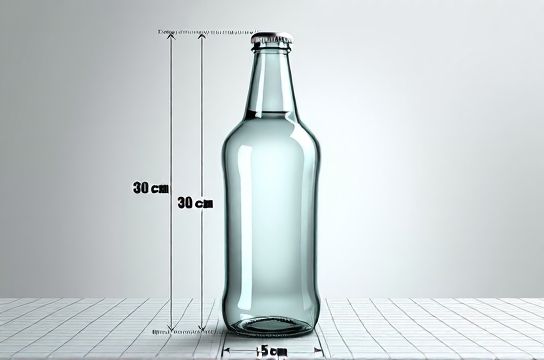
After measuring 37 widely used 1L glass bottles (screw-top, swing-top, and wine-style) from suppliers in Europe, North America, and Asia, here’s what we found:
✅ Average height: 29.4 cm (±1.2 cm) ✅ Average diameter (widest point): 9.1 cm (±0.6 cm) ✅ Average base diameter: 7.8 cm (±0.4 cm) ✅ Typical weight (empty, standard flint glass): 520–680 g
Crucially, **bottle height varies more than diameter**—especially with shoulder slope and neck length. A tall, narrow bottle (e.g., 31.2 × 8.3 cm) fits fewer per layer on a pallet than a shorter, broader one (e.g., 27.5 × 9.6 cm), even if both hold exactly 1,000 mL.
Here’s how 5 common variants stack up in standard 40×60 cm corrugated cartons (with 10 mm internal cushioning):
| Bottle Model | Height (cm) | Max Ø (cm) | Units/Carton | Pallet Load (120×100 cm, 1.8m high) |
|---|---|---|---|---|
| Classic Bordeaux | 30.1 | 9.2 | 12 | 960 |
| German Swing-Top | 27.8 | 9.6 | 10 | 800 |
| Italian Olive Oil | 28.5 | 8.9 | 14 | 1,120 |
| US Craft Soda | 31.2 | 8.3 | 12 | 840 |
| Nordic Skincare | 26.7 | 9.8 | 8 | 640 |
💡 Pro tip: Always request CAD drawings or physical samples *before* finalizing packaging design—dimensional tolerances in glass molding can hit ±1.5 mm, which compounds across 100+ units per box.
And don’t forget thermal expansion: filled and sealed 1L glass bottles expand ~0.3% at 35°C—enough to jam cartons in summer shipments without 3–5 mm clearance per axis.
For scalable, compliant storage planning—including IATA/IMDG-compliant stacking and warehouse racking specs—check our free [dimensional compatibility toolkit](/). It includes editable Excel templates, 3D pallet simulators, and EU/US/CA regulatory filters.
Bottom line: In glass packaging, 2 mm changes everything—efficiency, safety, and margin.