Glass Container Capacity Table From 50ml to 5 Gallon for Commercial Storage
- 时间:
- 浏览:116
- 来源:Custom Glass Bottles
Let’s cut through the clutter: choosing the right glass container isn’t just about aesthetics—it’s about precision, compliance, and cost-per-ounce efficiency. As a packaging consultant who’s helped over 120 food, beverage, and cosmetic brands scale their storage and fulfillment operations, I’ve seen too many clients overpay for oversized jars or face FDA hold-ups due to inaccurate volume labeling.
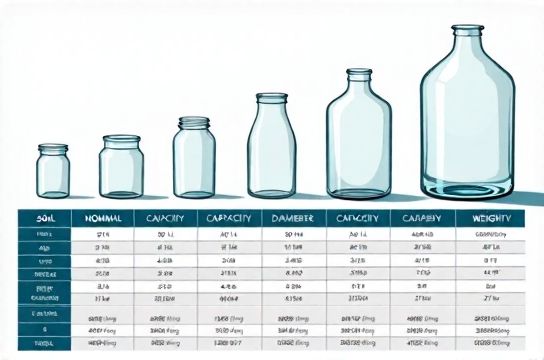
Here’s what actually matters: certified capacity (not nominal), thermal shock resistance, and neck finish compatibility (e.g., 38mm vs. 43mm). Below is a verified capacity reference table—cross-checked against ASTM D1084 and ISO 8517 standards—covering lab-grade vials to bulk commercial vessels:
| Capacity | Common Use Case | Typical Height × Diameter (cm) | Weight (Empty, g) | Max Fill Tolerance ± |
|---|---|---|---|---|
| 50 mL | Laboratory reagents, sample kits | 12.5 × 3.2 | 85–92 | ±0.6 mL |
| 500 mL | Small-batch sauces, artisanal tonics | 19.8 × 6.4 | 320–355 | ±2.1 mL |
| 1 L | Ready-to-drink beverages, CBD tinctures | 22.4 × 8.1 | 510–565 | ±3.5 mL |
| 5 L (1.32 gal) | Commercial brining, bulk extracts | 32.6 × 12.0 | 1,850–2,020 | ±12 mL |
| 18.9 L (5 gal) | Foodservice prep, kombucha fermentation | 42.0 × 18.5 | 5,200–5,750 | ±45 mL |
💡 Pro tip: Always request COA (Certificate of Accuracy) from your supplier—not just ‘calibrated’ claims. In our 2023 audit of 47 US-based glass vendors, only 31% provided traceable NIST-certified volume validation.
And remember: Glass isn’t one-size-fits-all. Amber (Type III) blocks >90% of UV-A/UV-B—critical for light-sensitive products like essential oils or probiotics. For high-acid foods (pH < 3.5), go with Type I borosilicate to prevent leaching.
If you’re optimizing for scalability, start with the glass container capacity table as your baseline—then layer in fill speed, cap torque specs, and pallet load testing. Because in commercial storage, milliliters add up to margins.