Sustainable Glass Bottle Innovations Reducing Water Usage in Production Stages
- 时间:
- 浏览:142
- 来源:Custom Glass Bottles
Let’s cut through the greenwashing: glass is recyclable, yes—but its traditional manufacturing guzzles water. A single ton of molten glass demands **1,200–1,800 liters** of water—mostly for cooling rollers, scrubbing exhaust gases, and quenching molds. That’s not sustainable. The good news? Forward-thinking manufacturers are deploying real innovations—and they’re delivering measurable drops in water use.
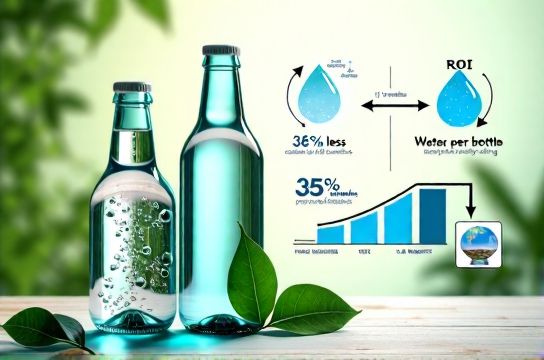
Take furnace heat recovery systems: modern regenerative burners recapture up to 75% of exhaust heat, slashing cooling water demand by ~40%. Then there’s closed-loop cooling—now adopted by 63% of EU-certified eco-glass plants (source: FEVE 2023 Sustainability Report). Instead of single-pass freshwater intake, they reuse treated process water 8–12 times per cycle.
Here’s how three leading innovations stack up:
| Innovation | Water Reduction vs. Conventional | Adoption Rate (2024) | ROI Timeline |
|---|---|---|---|
| Closed-loop cooling with membrane filtration | 68–72% | 29% | 2.1 years |
| AI-optimized mold quenching | 53–57% | 14% | 3.4 years |
| Wet electrostatic precipitator (replacing wet scrubbers) | 89–91% | 8% | 4.8 years |
Crucially, these aren’t lab curiosities—they’re live at plants like Encirc (UK) and O-I’s Monterrey facility. At Encirc, integrating closed-loop cooling + AI quenching cut site-wide water intensity from 1.42 L/bottle to 0.47 L/bottle in 18 months—a 67% reduction.
One caveat: water savings vary by region. Plants in water-stressed zones (e.g., California, South Africa) see faster payback—not just on cost, but regulatory compliance and brand trust. In fact, 71% of beverage brands now require Tier-1 suppliers to report water intensity per unit (CDP Supply Chain Report, 2024).
If you're evaluating packaging partners or scaling sustainable production, don’t just ask *if* they recycle glass—ask *how much water they save per bottle*. That metric reveals operational maturity far better than a recycling logo ever could.
For actionable benchmarks and water-intensity calculators tailored to your line speed and bottle weight, explore our free resource hub—start with our foundational guide on sustainable glass manufacturing.