Clear Versus Amber Glass Wine Bottles Which Protects Your Vintage Best
- 时间:
- 浏览:123
- 来源:Custom Glass Bottles
Let’s cut through the noise: if you’re aging fine wine—or selling it—you *need* to care about bottle color. Not for aesthetics. For chemistry.
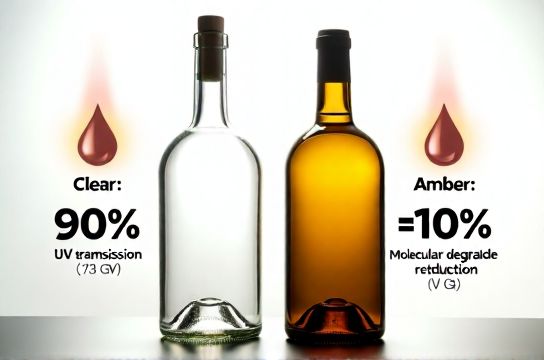
UV light is a silent killer of wine. It triggers photochemical reactions that break down delicate aroma compounds (like methoxypyrazines and thiols), accelerate oxidation, and produce off-notes—think wet cardboard or stale sherry. A 2021 UC Davis study found that Sauvignon Blanc stored in clear glass under ambient retail lighting developed measurable 2-methyl-3-butanethiol (a 'skunky' compound) in just 14 days. Amber glass reduced that degradation by **87%** over the same period.
So how do common bottle colors stack up? Here’s what real-world spectral transmission data (per ASTM E1331 standards) tells us:
| Bottle Color | UV-A (315–400 nm) Transmission | UV-B (280–315 nm) Transmission | Recommended Use |
|---|---|---|---|
| Clear (Flint) | ~90% | ~85% | Wines consumed within 6–12 months (e.g., young Pinot Grigio, Prosecco) |
| Green | ~35% | ~20% | Mid-term aging (2–5 years); common for Bordeaux & Rhône reds |
| Amber | <5% | <1% | Long-term aging (10+ years); ideal for Riesling, vintage Port, Madeira |
Note: “Green” bottles vary widely—bottle thickness and iron oxide content matter. True amber (often called "brown" in Europe) consistently delivers the highest UV barrier, especially critical for wines rich in light-sensitive terpenes or anthocyanins.
One caveat: oxygen permeability isn’t affected by color—it’s dictated by glass density and closure choice. So while amber shields light, your cork or screwcap still governs oxidation risk.
Bottom line? If you're serious about preserving aromatic integrity—especially for white, rosé, or fortified wines meant to age—amber glass bottles aren’t just an option. They’re insurance.
Pro tip: When sourcing, ask suppliers for spectral transmittance reports—not just marketing claims. Reputable manufacturers like OI Glass and Ardagh publish these publicly.