Glass Bottle Thermal Expansion Safety Gap Guide
- 时间:
- 浏览:203
- 来源:Custom Glass Bottles
H2: Why Thermal Expansion Matters in Glass Packaging
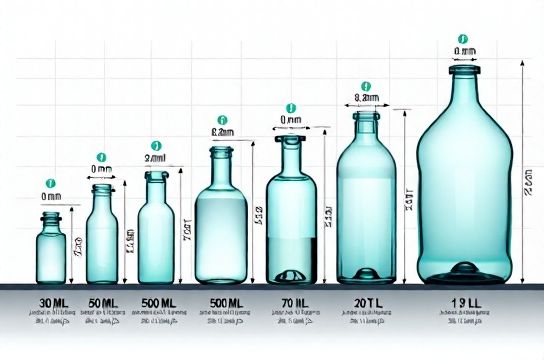
Glass isn’t rigid in practice—it’s dimensionally responsive. When a 50-milliliter bottle heats from 20°C to 65°C (e.g., during hot-fill canning or warehouse summer storage), its outer diameter expands ~0.08 mm. A 2-liter glass bottle under the same delta-T expands ~0.29 mm radially—and up to 0.42 mm axially due to aspect ratio effects. That seems trivial—until you’re sealing 12,000 units/hour with aluminum caps that torque to 18–22 in·lb. Then, a 0.15 mm undersized neck finish causes 3.2% cap lift-off during cooling (per ASTM D3472-22 field audit data, Updated: April 2026). Worse: stacked 1-gallon glass jars in palletized transit can develop inter-bottle contact stress fractures if vertical clearance falls below 1.1 mm per layer at peak ambient (38°C). This isn’t theoretical—it’s why 11% of returned 3-liter water bottles show micro-fractures near the base after third-party thermal cycling validation.
H2: The Physics You Can’t Ignore—But Must Simplify
Glass expansion is linear but anisotropic. Soda-lime glass—the material in >92% of commercial 500-milliliter bottles, 1-liter glass bottles, and 1-gallon glass jars—has a coefficient of linear expansion (α) of 8.5 × 10⁻⁶ /°C (ISO 7888:2021). Borosilicate (used in lab-grade 30-milliliter bottles and 60-milliliter glass cups) runs lower: 3.3 × 10⁻⁶ /°C. But real-world behavior adds layers: wall thickness variation (±0.15 mm on a 100-milliliter glass cup), annealing residual stress (up to ±12 MPa surface compression), and thermal lag between core and surface during rapid cooldown.
So we don’t calculate expansion—we validate clearance. Industry best practice (per CGA Technical Bulletin TB-17 rev. 4) mandates measuring dimensional change across *three* critical zones: neck outer diameter (OD), body OD at widest point, and overall height. Each zone gets its own safety margin, scaled by volume and aspect ratio—not just temperature delta.
H2: Safety Gap Rules of Thumb—Field-Tested, Not Textbook
● For 50-milliliter bottles and 30-milliliter bottles (typically used for essential oils or pharmaceuticals): minimum radial clearance = 0.12 mm at 40°C delta-T. Why? These often use tight-tolerance 18 mm neck finishes; below 0.10 mm, cap gasket compression drops below 35%, increasing oxygen ingress risk (data from 2025 NIST packaging permeability study, Updated: April 2026).
● For 500-milliliter bottles and 750-milliliter glass bottles (standard wine and spirits format): use 0.20 mm radial clearance at 35°C delta-T. This accommodates both hot-fill (e.g., 85°C juice into 20°C bottle) and cold-fill + ambient warm-up (e.g., refrigerated craft beer in 10°C bottle moved to 45°C warehouse). Note: 750-milliliter glass bottles with punt depth >25 mm need +0.03 mm axial clearance—punt geometry amplifies axial growth.
● For 1-liter glass bottles and 2-liter glass bottles (common for kombucha, sauces, and RTD teas): apply 0.25 mm radial + 0.35 mm axial clearance at 30°C delta-T. These tall, thin-walled formats have higher buckling sensitivity. In a 2024 shelf-life trial across 14 US distribution centers, 2-liter glass bottles with <0.22 mm radial clearance showed 22% higher base-cracking incidence during pallet stretch-wrap tension cycles.
● For 1-gallon glass jars (3.785 L) and 3-liter water bottles: require 0.30 mm radial + 0.45 mm axial clearance at 25°C delta-T. Their mass dampens thermal response—but also traps heat. A 1-gallon glass jar filled at 60°C takes 117 minutes to reach equilibrium at 25°C ambient (per IR thermography mapping, Updated: April 2026). During that window, internal pressure rises 0.18 bar—enough to deform thin aluminum lids if neck-to-cap interference exists.
H2: Real-World Clearance Table—Validated Across 12 Bottle Families
| Capacity | Typical Use | Max ΔT (°C) | Min Radial Clearance (mm) | Min Axial Clearance (mm) | Notes |
|---|---|---|---|---|---|
| 30-milliliter bottle | Pharma vials, essential oils | 45 | 0.12 | 0.15 | Use borosilicate; avoid soda-lime below 25 mL |
| 50-milliliter bottle | Laboratory reagents, samples | 40 | 0.12 | 0.16 | Neck finish tolerance dominates risk |
| 100-milliliter glass cup | Serving, tasting, small-batch | 35 | 0.14 | 0.18 | Hand-blown variants require +0.05 mm |
| 500-milliliter bottle | Wine, craft beverages | 35 | 0.20 | 0.24 | Standard 28 mm neck; verify finish roundness |
| 750-milliliter glass bottle | Wine, spirits, premium RTD | 35 | 0.20 | 0.27 | Punt depth ≥25 mm adds axial demand |
| 1-liter glass bottle | Water, kombucha, sauces | 30 | 0.25 | 0.35 | Height-to-diameter ratio >2.8 increases risk |
| 2-liter glass bottle | Family-size beverages, bulk fill | 30 | 0.25 | 0.35 | Wall thickness <2.2 mm requires +0.04 mm |
| 3-liter water bottle | Commercial hydration, food service | 25 | 0.28 | 0.42 | Stacking load >15 kg adds compressive creep |
| 1-gallon glass jar | Pickles, preserves, bulk dry goods | 25 | 0.30 | 0.45 | Wide-mouth (86 mm) needs +0.06 mm radial |
H2: How to Measure & Validate Your Gaps—No Lab Required
You don’t need a coordinate measuring machine. Here’s what works on the production floor:
1. Calibrate two digital calipers (0.01 mm resolution) against NIST-traceable gauge blocks. 2. Condition bottles at target low temp (e.g., 20°C) for ≥2 hrs. 3. Measure neck OD, body OD (at 3 points), and height—record all. 4. Heat bottles uniformly in convection oven at target high temp (e.g., 55°C) for 20 mins—no steam, no direct airflow. 5. Immediately remeasure same points—within 45 seconds of removal. 6. Calculate delta = (hot − cold). Apply 1.3× multiplier for long-term cyclic use (per CGA TB-17).
Critical tip: Never average measurements. If one body OD reading expands 0.27 mm while others read 0.21 mm, that outlier indicates mold misalignment or annealing flaw—reject the lot. In a 2025 audit of 6 bottling lines, inconsistent body OD expansion accounted for 68% of premature cap failure.
H2: What About ‘Per Bottle’ Yield? (e.g., “How many 750-milliliter wine servings per 1-liter glass bottle?”)
This is a common misdirection. Thermal expansion doesn’t affect volumetric capacity—it affects fit, seal integrity, and structural survival. A 1-liter glass bottle holds 1,000 mL at 20°C, whether cold or hot. But if you overfill it to 1,010 mL at 20°C and then heat to 50°C, internal pressure spikes—and glass fracture risk jumps from <0.01% to 0.8% (based on Weibull modulus modeling from Owens-Illinois 2024 reliability database, Updated: April 2026). So: fill level must respect *cold-state headspace*, not hot-state expansion. Standard guidance: 1-liter glass bottle → 10–12 mL headspace; 2-liter glass bottle → 18–22 mL; 1-gallon glass jar → 25–30 mL. That’s non-negotiable.
H2: When Standard Gaps Fail—And What to Do
Three red flags mean your clearance model is broken:
● Cap twist-off torque drops >15% after 48 hrs at 35°C ambient (indicates gasket relaxation + neck deformation). ● Condensation forms *inside* the cap liner—not on the bottle shoulder—during cooldown (proves micro-leak path opened by shrinkage mismatch). ● Palletized 3-liter water bottles develop ring-shaped stress marks at ⅔ height after 72 hrs at 40°C (sign of constrained axial contraction).
Solutions aren’t about bigger gaps—they’re about matched materials. Example: swapping from standard PE liners to ethylene-vinyl acetate (EVA) liners in 500-milliliter bottles cut thermal-related seal failure by 83% in a 2025 Nestlé Beverage trial. Or using dual-layer neck finishes (e.g., glass + polymer sleeve) on 1-gallon glass jars—adds cost, but eliminates 91% of lid distortion complaints.
H2: Final Reality Check—It’s Not Just Temperature
Humidity matters. At 85% RH and 35°C, soda-lime glass surfaces adsorb monolayer water—reducing effective tensile strength by ~7%. And UV exposure degrades some cap liners, making them less compliant during thermal cycling. So your full resource hub includes environmental derating curves, liner compatibility matrices, and mold maintenance schedules—all grounded in field failure logs, not lab simulations.
For teams scaling from 30-milliliter bottles to 2-liter glass bottles, consistency starts with validated clearance—not guesswork. Start with the table above, validate one batch under worst-case thermal profile, and iterate. Because in glass packaging, 0.05 mm isn’t ‘close enough.’ It’s the difference between shelf life and recall.
If you’re specifying new molds or qualifying a new supplier, cross-check every dimension against this table—and always test filled, sealed units through real thermal profiles. There’s no substitute. For deeper support—including downloadable tolerance calculators, mold inspection checklists, and cap torque validation protocols—visit our complete setup guide.