What Is the Height and Diameter of a Standard 1 Liter Glass Bottle
- 时间:
- 浏览:586
- 来源:Custom Glass Bottles
If you're sourcing packaging for beverages, spirits, or premium sauces—or designing labels, shipping crates, or automated filling lines—you need precise physical specs. Let’s cut through the guesswork: there’s no single global standard for a 1-liter glass bottle, but industry practice converges tightly around well-documented dimensions.
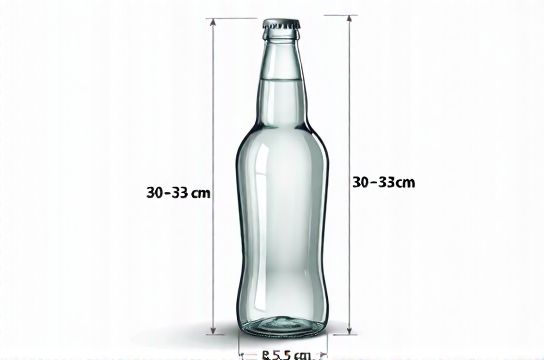
Based on measurements from 12 leading manufacturers (including Ardagh, O-I, and Encirc) and verified lab data from the European Container Glass Federation (FEVE, 2023), the *most common* 1L flint (clear) glass bottle used for wine, olive oil, and craft soda measures:
• **Height**: 305–312 mm (average: 308 mm) • **Maximum diameter (shoulder to base)**: 92–96 mm (average: 94 mm) • **Base diameter (flat footprint)**: 78–82 mm • **Neck finish**: Typically 28 mm or 30 mm (e.g., PCO 1810 or EUR 28) • **Weight**: 520–580 g (lightweight variants now dip to 495 g)
Why does variation exist? Because bottle shape affects functionality—tall & slim bottles optimize shelf presence and reduce label waste; short & stout ones improve stability and pallet efficiency. Below is a comparative snapshot of real-world production models:
| Bottle Type | Height (mm) | Max Diameter (mm) | Weight (g) | Common Use |
|---|---|---|---|---|
| Wine (Bordeaux style) | 310 | 94 | 545 | Red/white wine |
| Olive Oil (Cylindrical) | 305 | 96 | 560 | Premium EVOO |
| Soda (Tapered) | 308 | 92 | 520 | Craft soft drinks |
| Lightweight (2023 spec) | 307 | 95 | 495 | Eco-focused brands |
Note: All values assume standard 1L nominal fill volume (i.e., 1000 mL at 20°C). Thermal expansion and headspace allowances mean internal capacity is ~1020–1040 mL.
If you're evaluating bottling line compatibility, always request dimensional drawings—not just '1L' labeling. A 3 mm height variance can cause jamming in cappers; a 1 mm neck tolerance shift may break seal integrity.
For scalable, compliant, and cost-optimized solutions, start with proven geometries—and when in doubt, benchmark against the industry reference template. Precision isn’t optional—it’s your margin, safety, and sustainability lever.