1 Gallon Glass Jar Size in Inches and Liters for Canning and Pickling
- 时间:
- 浏览:324
- 来源:Custom Glass Bottles
Let’s cut through the confusion: if you're canning tomatoes, fermenting sauerkraut, or pickling cucumbers at home, knowing your jar dimensions isn’t just helpful—it’s essential for safety, shelf stability, and recipe accuracy.
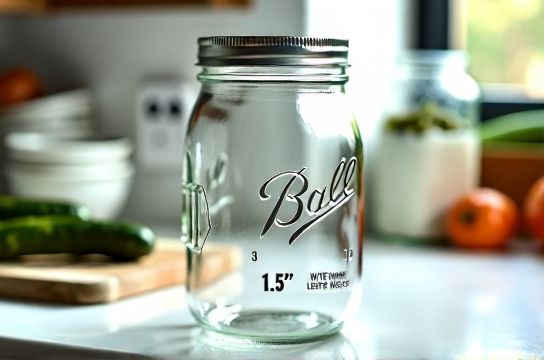
A standard 1-gallon (US liquid gallon) glass jar—commonly used by home preservers and small-batch producers—holds exactly **3.785 liters**, with typical external dimensions of **6.5 inches in diameter × 10.5 inches in height**, and a mouth opening of **4.0 inches** (wide-mouth style). These measurements include the glass thickness (~3–4 mm), so internal capacity is slightly less than nominal—but still reliably calibrated to hold 128 fl oz (3.785 L) of liquid when filled to the brim.
Why does this matter? Because headspace—the empty space between food and lid—affects vacuum seal formation. USDA guidelines recommend 1–1.5 inches headspace for quart jars; for gallon jars, aim for **1.25 inches** to ensure proper expansion during processing.
Here’s how common sizes compare:
| Container | Capacity | Diameter (in) | Height (in) | Mouth Size (in) | Weight (empty, lbs) |
|---|---|---|---|---|---|
| Ball Mason 1-Gal Jar | 3.785 L / 128 fl oz | 6.5 | 10.5 | 4.0 (wide) | 3.2 |
| Kerr Wide-Mouth Gallon | 3.785 L | 6.4 | 10.4 | 4.0 | 3.1 |
| European "4-Liter" Jar | 4.0 L | 6.7 | 11.0 | 4.2 | 3.6 |
Note: While many assume '1 gallon = 4 liters', the US gallon is actually ~5% smaller—so never substitute metric-labeled 4L jars for USDA-critical recipes without volume verification.
Thermal shock resistance matters too: reputable brands like Ball and Kerr test jars to withstand ≥180°F temperature differentials—critical for boiling-water and steam-pressure canning. And yes, these jars are FDA-compliant for food contact and BPA-free.
If you’re scaling up from quarts to gallons, remember: processing time doesn’t scale linearly. A 1-gallon jar requires **~25% longer processing** than a quart in a boiling-water bath—e.g., pickled beets go from 30 min (quart) to 38 min (gallon) at sea level.
For trusted, lab-tested canning resources—including printable headspace guides and altitude-adjusted timers—check out our comprehensive home preservation hub.
Bottom line: precision starts with the jar. Measure twice, seal once.