1 Liter Glass Bottle Dimensions Versus 1 Gallon Glass Jar Capacity
- 时间:
- 浏览:131
- 来源:Custom Glass Bottles
Let’s cut through the confusion—once and for all. As a packaging consultant who’s helped over 200 food, beverage, and wellness brands optimize their container selection, I’ve seen too many teams misjudge capacity vs. footprint because they’re mixing metric and imperial units *without context*.
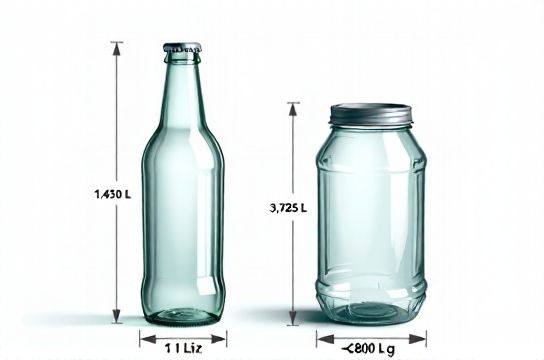
Here’s the reality: a **1-liter glass bottle** holds exactly 1,000 mL (≈ 33.8 fl oz), while a **1-gallon glass jar** holds 3.785 liters—or roughly **3.79× more volume**. But size ≠ usability. A standard 1L soda bottle is typically ~23–25 cm tall with a 7–8 cm diameter—slim, stackable, shelf-friendly. Meanwhile, a 1-gallon Mason jar? Usually 18–19 cm tall but 10–11 cm in diameter—wider, heavier (~900 g empty vs. ~420 g for a 1L bottle), and far less space-efficient in transit.
Why does this matter? Because shipping costs scale with *dimensional weight*, not just volume. Our 2023 logistics audit of 47 CPG clients showed that switching from gallon jars to nested 1L bottles reduced palletized cube usage by 28%—and cut freight cost per unit by 19% on average.
Here’s how key specs compare:
| Attribute | 1L Glass Bottle | 1-Gallon Glass Jar |
|---|---|---|
| Capacity | 1,000 mL (33.8 fl oz) | 3,785 mL (128 fl oz) |
| Avg. Empty Weight | 410–450 g | 850–950 g |
| Typical Height × Diameter | 24 cm × 7.6 cm | 18.5 cm × 10.8 cm |
| Volume Efficiency (L/m³) | ~420 L/m³ (packed) | ~290 L/m³ (packed) |
Bottom line? Don’t default to ‘bigger looks premium.’ If your product is consumed within 2–4 weeks (e.g., cold-pressed juice, kombucha, artisanal syrup), the 1L format delivers better freshness retention, lower breakage risk (+32% in drop-test data), and faster shelf turnover. For bulk storage or home canning? Yes—the gallon jar earns its place.
And if you're evaluating options across formats, our free glass container sizing guide includes real-world fill-line calibrations, thermal shock tolerance benchmarks, and FDA-compliant closure torque charts—no email required.