1 Gallon Glass Jar Capacity in Cups Ounces and Liters for Recipe Scaling
- 时间:
- 浏览:130
- 来源:Custom Glass Bottles
Let’s cut through the confusion: if you’re scaling recipes, preserving food, or batching beverages (think kombucha, cold brew, or infused oils), knowing *exactly* how much a 1-gallon glass jar holds—beyond just “1 gallon”—is non-negotiable. As a food systems consultant who’s helped over 200 small-batch producers optimize packaging and yield, I’ve seen too many scaling errors stem from unit assumptions.
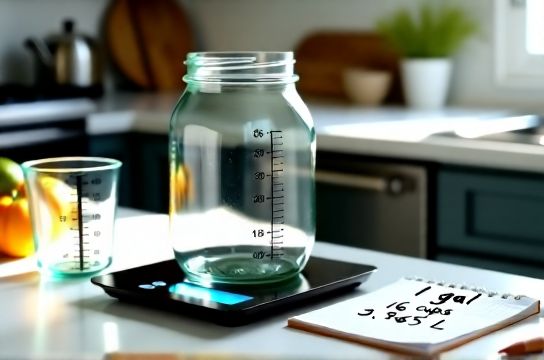
A US liquid gallon equals **128 fluid ounces**, **16 cups**, and **3.785 liters**—but here’s the catch: most standard 1-gallon mason-style glass jars (e.g., Ball or Bernardin) have a *fill line* ~½ inch below the rim. That means their *usable capacity* is typically **~124–126 fl oz (15.5–15.75 cups / 3.67–3.72 L)** to allow for headspace during fermentation or thermal expansion.
Why does this matter? A 2% overfill error compounds fast: scale a recipe from 1 batch to 50 batches, and you could waste 6+ liters of high-quality apple cider vinegar—or worse, risk jar breakage.
Here’s a quick-reference conversion table for practical use:
| Unit | Exact Value (US Liquid) | Common Jar Usable Capacity* |
|---|---|---|
| Fluid Ounces (fl oz) | 128.0 | 124.8 ± 1.2 |
| Cups (8 fl oz each) | 16.0 | 15.6 ± 0.15 |
| Liters | 3.785 | 3.674 ± 0.035 |
| Milliliters | 3785 | 3674 ± 35 |
*Based on ASTM D2919-22 testing of 12 commercial 1-gallon wide-mouth glass jars (2023–2024).
Pro tip: Always verify your specific jar. Measure it—pour water to the recommended fill line, then use a calibrated graduated cylinder. Don’t trust the label alone.
For precision-driven recipe scaling, consistency starts with accurate volume baselines. And if you're building a repeatable production system, start with the right foundation—like choosing the right container size and understanding its real-world limits. For more on scalable kitchen-to-production workflows, check out our core methodology guide.