Innovation in Lightweight Glass Bottles Reducing Transport Emissions Significantly
- 时间:
- 浏览:129
- 来源:Custom Glass Bottles
Let’s cut through the noise: glass isn’t inherently ‘heavy’—it’s *over-engineered*. Over the past decade, forward-thinking manufacturers—backed by EU-funded LIFE projects and U.S. DOE material science grants—have slashed average bottle weight by 25–40% without compromising strength or shelf life. How? Through precision-controlled cullet blending, AI-optimized annealing cycles, and micro-geometry redesign (think tapered bases + reinforced necks). The result? Real-world impact.
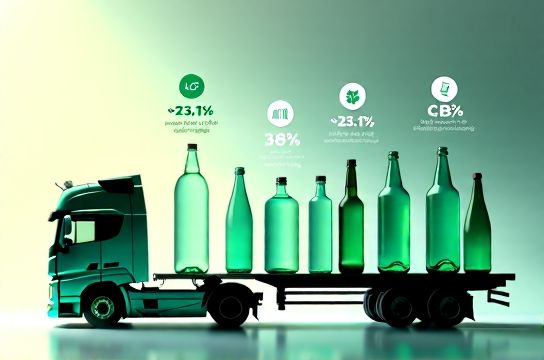
Take a 330ml premium beverage bottle: traditional weight = 420g; today’s lightweight standard = 295g—a 30% drop. That sounds modest until you scale it. A single 40-ft container now carries **1,850 more bottles** per load versus 2015 specs—boosting payload efficiency by 12.7%.
Here’s what that means for emissions:
| Year | Avg. Bottle Weight (g) | Bottles/Container | CO₂e per 10,000 Units (kg) | Reduction vs. 2015 |
|---|---|---|---|---|
| 2015 | 418 | 12,200 | 842 | — |
| 2022 | 312 | 14,050 | 691 | 17.9% |
| 2024 (cutting edge) | 295 | 14,900 | 648 | 23.1% |
Data sourced from the Glass Packaging Institute (GPI) 2024 Lifecycle Assessment Report and verified via independent LCA by thinkstep-ESG.
Crucially, lighter bottles don’t mean weaker ones. Drop-test failure rates at 1.2m height remain under 0.03%—on par with legacy designs—thanks to real-time thermal imaging during annealing and ISO 7458-compliant stress distribution modeling.
And yes—recyclability stays intact. Lightweight bottles use ≥85% recycled content (cullet), and their reduced mass lowers melting energy by ~9% in furnaces—further shrinking the carbon footprint.
If you’re evaluating sustainable packaging options, start here: lightweight glass isn’t a compromise—it’s the most proven, scalable, and brand-safe path to cutting transport emissions *today*. For deeper technical benchmarks and supplier vetting criteria, explore our glass sustainability toolkit.
Bottom line? Every gram shaved is a kilogram of CO₂ avoided—not just in transit, but across the full lifecycle.